
Last updated September 20, 2026
Free on-site gate assessment - hinges, posts, and your LiftMaster or Nice gate operator checked before anything is quoted
The assessment is free and the quote is the invoice.
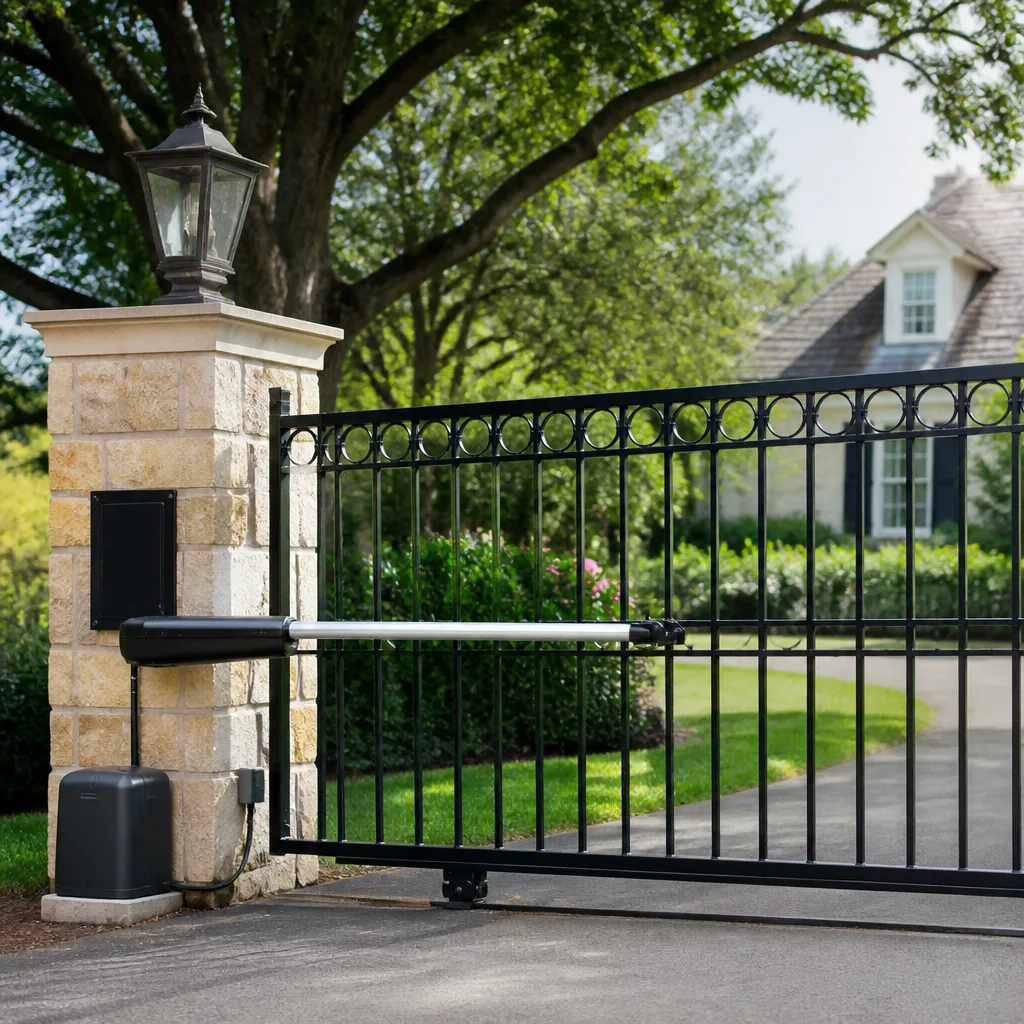
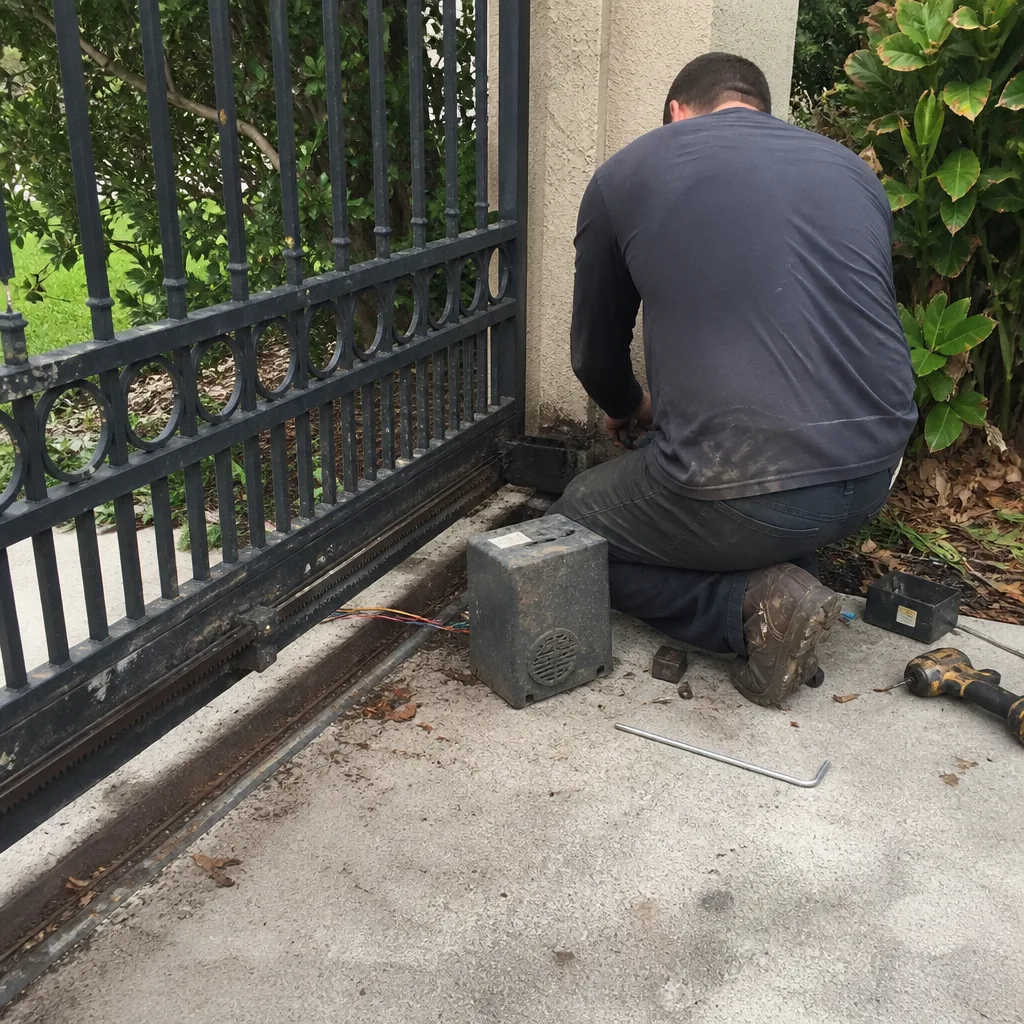 Before
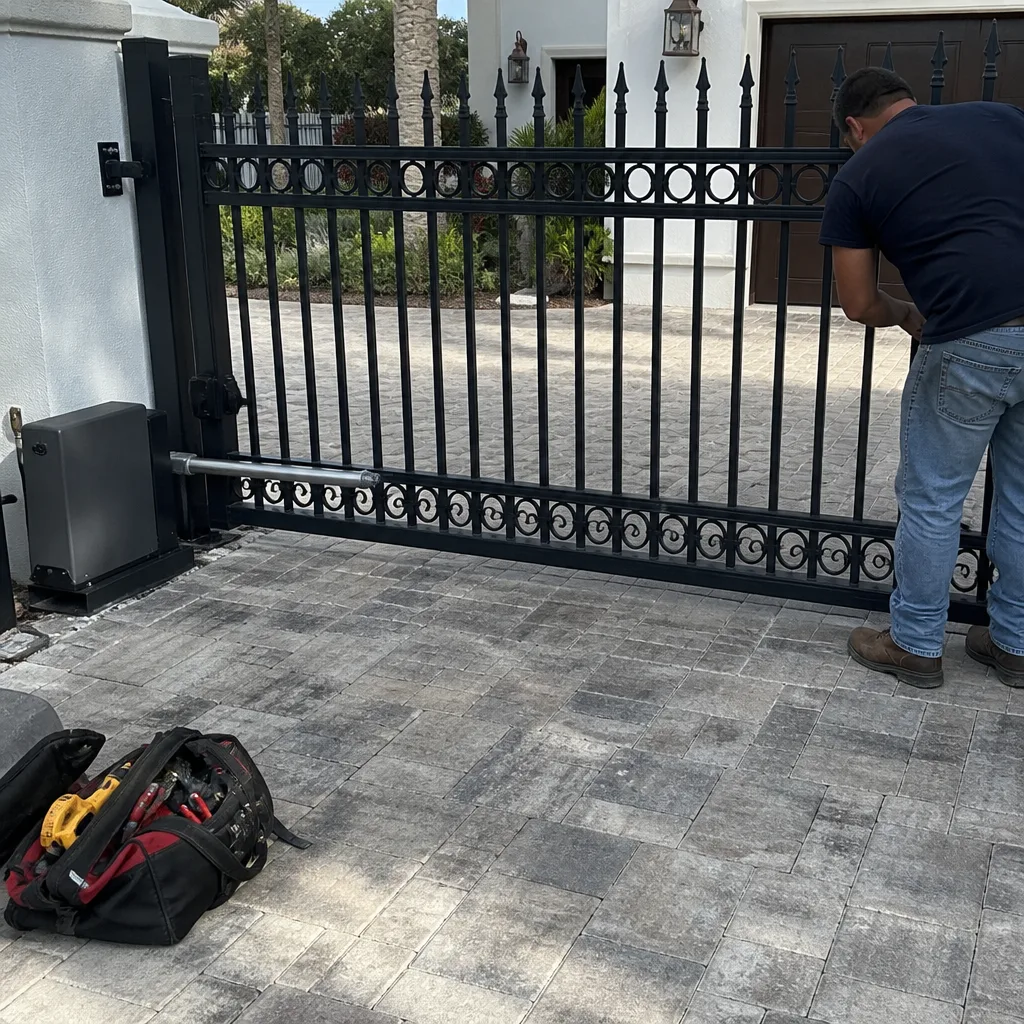 After
After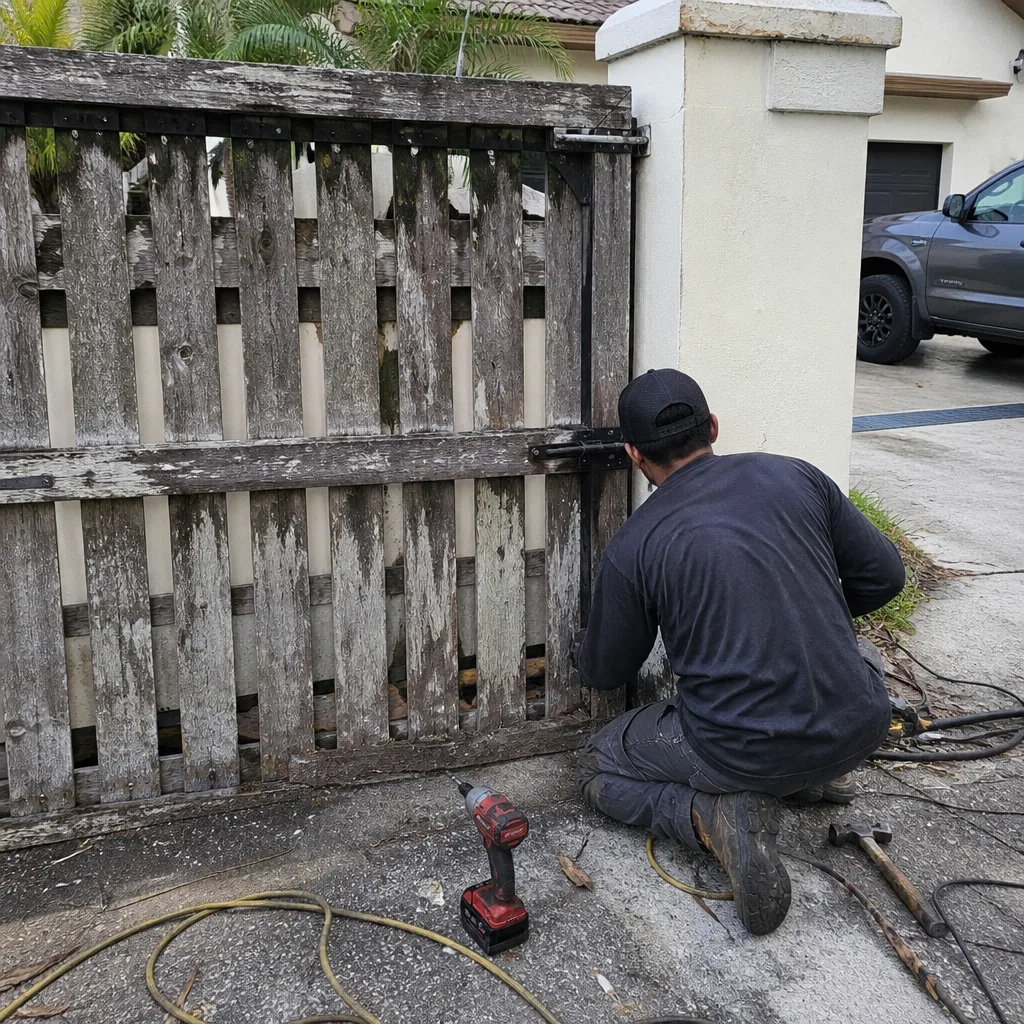 Before
 After
After Before
 After
AfterSeasonal Gate Repair Care for Boca Raton: Year-Round Homeowner’s Guide
Hurricane season ends October 31st, but in Boca Raton, most gate failures from seasonal stress show up in November. Homeowners stop looking right when the damage starts to declare itself. A gate that held throughout the storms has spent six months absorbing salt air, torrential rain, and thermal expansion. Now the dry season arrives, the metal contracts, and every weakened weld, corroded terminal, and misaligned limit switch gets exposed. This guide covers the two-cycle maintenance logic Boca Raton actually needs: wet-season hardening and dry-season recalibration. For a deeper dive, see The Complete Guide to Gate Repair in Boca Raton. You’ll learn what to inspect, when to inspect it, and how to build a written record so year-over-year drift becomes visible instead of mysterious.
Quick Answer
Seasonal gate maintenance in Boca Raton means two focused cycles per year, not four. In April and May, you harden the gate against six months of humidity, rain, and salt air by treating corrosion points, confirming drainage, and documenting baseline positions. In November and December, you recalibrate limit switches, retension chains, and inspect for the contraction damage that dry-season cooling reveals after hurricane season ends. A written photo log taken during each cycle is the single most valuable tool for catching slow drift before it becomes a $900 emergency Gate Repair.
Table of Contents
- Why Boca Raton Needs Its Own Gate Maintenance Calendar
- The Wet Season Protocol: April Through May
- Storm Season Gate Triage: What Fails First and What to Check After Every Tropical Event
- The Dry Season Recalibration: November Through January
- The Salt-Air Corrosion Calendar: Which Parts Fail, When, and in What Order
- Building a Seasonal Photo Log: The Written Record That Makes Drift Visible
- Common Mistakes to Avoid
- When to Call a Professional
- Frequently Asked Questions
- The Bottom Line
BeforeAfterWhy Boca Raton Needs Its Own Gate Maintenance Calendar
National gate maintenance guides assume four seasons. They tell you to lubricate in spring, inspect in summer, tighten in fall, and winterize. That template fails in Boca Raton because the environmental stresses here don’t follow a four-quarter rhythm. We get two long seasons with very different failure profiles. From May through October, humidity averages above 70 percent, afternoon thunderstorms arrive with regularity, and the tropical systems that brush or strike the coastline dump inches of rain in hours. From November through April, the air dries out, temperatures moderate, and the gate’s metal components contract. Each season produces its own signature damage, and a homeowner who treats the gate on a national schedule ends up inspecting for problems that aren’t coming and missing the ones that are.
We’ve serviced gates in every corner of Boca Raton, from the waterfront properties along the Intracoastal in Royal Palm Yacht & Country Club to the inland communities of Boca Del Mar and Loggers’ Run. The corrosion patterns differ by distance from salt water, but the seasonal timing holds across the city. A gate half a mile from the beach corrodes faster than one in central Boca Raton, but both gates swell in August and contract in December. The maintenance logic is the same; only the intensity of the corrosion piece changes.
One more local factor matters: the irrigation that keeps Boca Raton landscaping green. Sprinkler overspray hits gate columns and track rails daily in many communities. That water carries the same minerals and salts as rainfall, but it lands on the gate in a fine mist that dries quickly, concentrating whatever it leaves behind. We find more rust on the bottom six inches of swing gate posts than anywhere else, and irrigation overspray is almost always part of the story. A seasonal maintenance plan for Boca Raton has to account for this second water source that most national guides never mention.
The Wet Season Protocol: April Through May
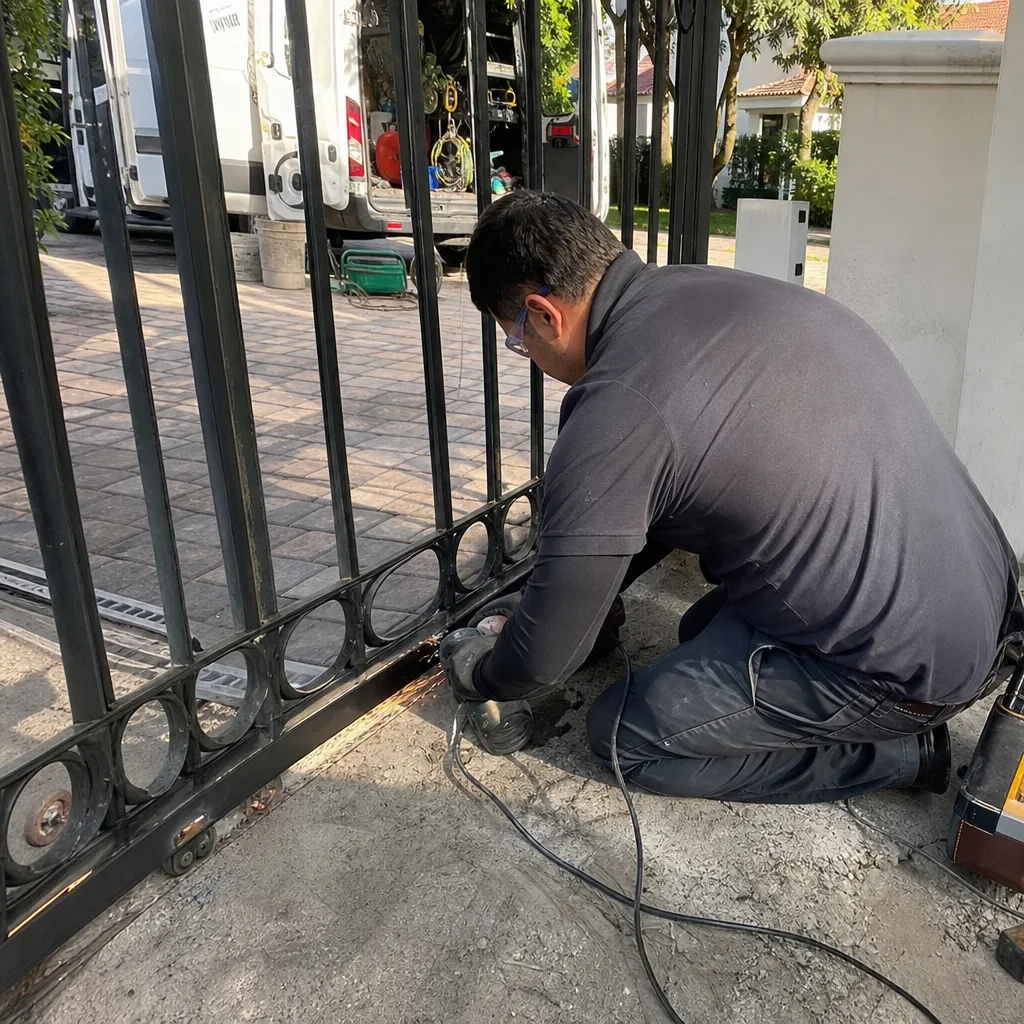
The wet season in Boca Raton runs from roughly mid-May through late October. April and early May are your hardening window. This is when you prepare the gate for six months of moisture, heat, and the possibility of tropical weather. The goal is not to make the gate waterproof; that’s impossible in this climate. The goal is to remove the conditions that let moisture do accelerated damage and to document where everything sits before the stress begins.
Here is the pre-wet-season inspection, in order of priority:
- Check every fastener for loose thread engagement. Aluminum and steel expand in heat, and by November the same screws will have gone through hundreds of expansion and contraction cycles. A screw that’s slightly loose in April will be loose in a different way by October. Tighten hinge bolts, post brackets, and track fasteners now, with a torque wrench if you have one. Note the torque values in your photo log.
- Inspect and treat the hinge points. Boca Raton’s humidity attacks hinges from the inside out. Wipe each hinge pin and bushing clean, inspect for rust bloom around the pin, and apply a marine-grade lubricant if the hinge design allows. If the hinge is sealed or has a grease fitting, check the fitting is clear and add grease. Do not ignore a squeaking hinge; the noise is the sound of metal wearing metal.
- Test the photo-eye alignment. The photo-eye, or infrared beam that stops the gate if something crosses its path, drifts more during wet season than any other component. Expanding metal shifts the mounting brackets. Misalignment of even two inches can cause the gate to reverse mid-cycle or refuse to close at all. Set the beam alignment now and photograph the position.
- Confirm drainage around the gate posts and track. Standing water is a gate killer in Boca Raton. After a heavy rain, a swing gate post sitting in a puddle is soaking its concrete footing. A slide gate track holding water is corroding its rollers from the bottom. Check that the ground slopes away from the posts and that the track has clear drainage channels. If you see standing water after a normal afternoon storm, that’s a problem to address before hurricane season starts.
- Document the gate’s full-swing or full-travel position. Take a photo of the gate in its fully open and fully closed positions. Note any gap at the latch, any sag at the free end, and any place where the gate scrapes or binds. These baseline photos are what you compare against in November.
This protocol takes a careful homeowner about ninety minutes on a single swing gate. A slide gate with track rails takes a bit longer because of the roller and track inspection. The time investment is worth it. Homeowners who complete a thorough April hardening pass consistently have fewer urgent repairs in September and October, when every gate company in Boca Raton is booked solid responding to storm damage. If you’d rather have a documented professional pass, gate repair in Boca Raton with a written inspection record is available through our team at Vance Gate Repair Boca Raton.
Storm Season Gate Triage: What Fails First and What to Check After Every Tropical Event
After any tropical storm or hurricane passes through Boca Raton, the instinct is to check the gate for obvious damage: is it bent, is it standing, does it still open. That’s a start, but the failures that matter most after a storm are rarely the visible ones. Based on our service calls after every significant weather event in Boca Raton, here is the order of failure likelihood, from most to least common:
- Limit switch drift. Wind load flexes the gate and the frame, and the actuators that read gate position shift. The gate may now stop six inches short of full close or overrun its normal travel. You’ll notice the gate doesn’t close flush or the motor hums after the gate reaches its stop.
- Control board fault codes. Water intrusion into the control box, even from wind-driven rain rather than flooding, causes fault codes on almost every major automation brand. FAAC, BFT, Linear, and Viking boards all have diagnostic LEDs that tell you something is wrong before the gate stops working entirely. Learn where your board is and what a normal LED pattern looks like.
- Photo-eye or safety edge faults. Debris, salt film, or shifted brackets knock the photo-eye out of alignment. A safety edge can also trap leaves or small branches, causing false obstruction readings. The gate behaves erratically, reversing for no visible reason.
- Concrete anchor loosening. Saturated soil expands the ground around the gate posts. When the water drains, the soil contracts and the post shifts fractions of an inch. Enough of this cycle, and the anchor bolts holding the operator arm bracket loosen. Test each anchor with a wrench; if any turn with less than rated torque, address them before the next storm.
- Chain or belt tension loss. Less common but serious. If a branch or debris wedged against the gate during the storm, the strain may have stretched a chain or belt. The gate now slips or jerks mid-travel.
The post-storm check takes about twenty minutes once you know what you’re looking at. Start with the control board, because fault codes are the fastest diagnostic signal. Then check the limit switch travel against your baseline photos. Then test the safety devices. Then check the anchors and the drive tension. This sequence catches roughly 90 percent of storm-related issues before they become gate outages. Our team at Vance Gate Repair Boca Raton has been performing this triage since 2014, and every storm event in Boca Raton produces the same failure pattern in the same order.
The Dry Season Recalibration: November Through January
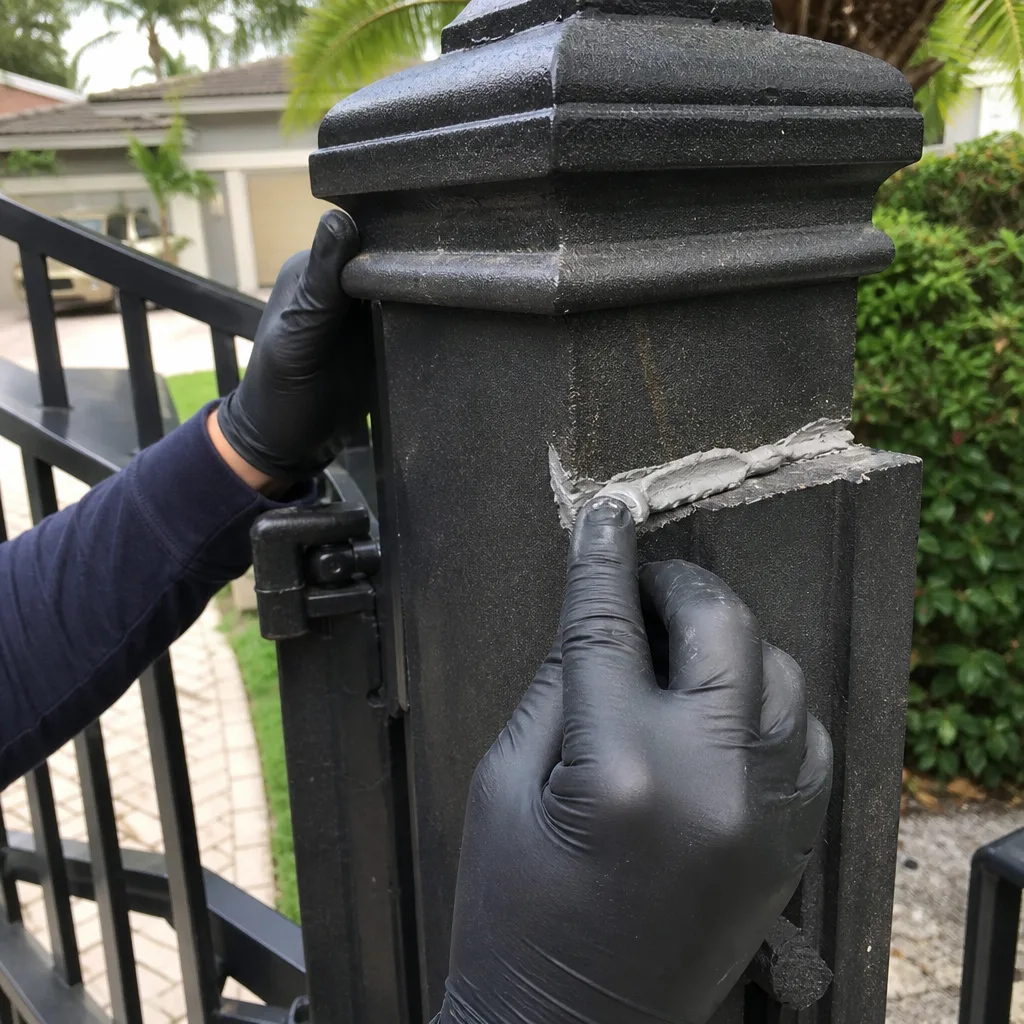
Boca Raton’s dry season runs from late October through April. The air gets drier, the afternoons get cooler, and the gate’s metal contracts. This contraction is the source of a whole category of problems that homeowners misdiagnose as motor failure or battery issues. In reality, the gate itself changed shape by fractions of an inch, and every calibrated setting from the wet season is now slightly wrong.
Here is what contraction does and how to correct it:
Limit switches drift. The gate’s travel limits are set when the metal is at one temperature. When the aluminum or steel frame contracts in cooler, drier air, the gate’s full travel distance changes slightly. A gate that closed perfectly in September now stops a quarter-inch short or slams into the close stop. The fix is recalibration, not replacement. The limit switch position needs to be reset to match the gate’s current travel. We routinely see Boca Raton gates where the limit switch was set 12 degrees past travel; a technician resets it, photographs the new position, and the gate works correctly again.
Chain and belt tension changes. A drive chain that was properly tensioned in humid August may now be too loose in dry December. The metal links contract, and the effective chain length shortens. Too loose, and the gate jerks on startup. Too tight, and the chain wears the drive sprocket prematurely. Check tension at the midpoint of the run. A properly tensioned chain should deflect about a quarter-inch under moderate finger pressure. If you’re not comfortable making this judgment, it’s a five-minute adjustment on most residential gates.
Post alignment shifts. The gate posts sit in concrete footings that don’t move with the metal. But the soil around the footings dries out during the dry season, and the footing can settle or tilt slightly. A swing gate that scraped the ground all summer may now swing freely, or the opposite: a gate that cleared the ground in August now drags because the post settled. Either way, the gate’s geometry has changed and the operator is working against a new load.
The dry-season recalibration pass should take place in November, after the first cool front has arrived and the gate has contracted to its dry-season dimensions. Do not recalibrate in January and expect those settings to hold into May; the gate will expand again when the humidity returns. The recalibration is seasonal maintenance, not a permanent fix. Document every adjustment in your photo log so you can compare year over year. A homeowner who records these settings annually can spot a worsening trend, like a post that settles a little more each winter, and address the root cause before it becomes a structural problem. For a professional recalibration, gate motor and opener service in Boca Raton is available with the same written documentation we provide on every job.
The Salt-Air Corrosion Calendar: Which Parts Fail, When, and in What Order
Every gate in Boca Raton lives in a salt-air environment, but the intensity varies enormously by location. A gate on the barrier island or within a mile of the ocean in Highland Beach or Boca Raton’s eastern neighborhoods takes a fundamentally different corrosion load than a gate in west Boca Raton. What doesn’t change is the order in which components fail. Salt air attacks the same parts in the same sequence everywhere; the only variable is speed.
Here is the corrosion calendar, in order of failure:
- Exposed steel fasteners (years 1 through 3). The zinc coating on standard steel screws and bolts is the first casualty. On coastal Boca Raton properties, this starts within 18 months of installation. The fastener grows a white bloom first, then rust. By year three, the head may be too corroded to remove without drilling. Replace with stainless steel or marine-grade coated fasteners.
- Terminal connections inside the control box (years 2 through 5). Corrosion creeps into the low-voltage terminals that connect the photo-eyes, the safety edges, the keypad, and the operator. Green corrosion on a terminal causes voltage drop, which makes the gate behave erratically long before it stops working. A gate that opens fine but sometimes doesn’t close, or vice versa, often has a corroded terminal, not a failing motor.
- Hinge pins and bushings (years 3 through 6). The hinge is a wear point and a corrosion point simultaneously. Salt air accelerates both. A corroded hinge pin will still turn, but it’s grinding against the bushing, producing metal particles that accelerate wear. We hear it first as a squeak, then as a groan, and finally as a gate that sags because the hinge has worn out of round.
- Weld joints on steel and iron frames (years 4 through 8). Weld joints are the weak point for corrosion on any welded frame. Rust gets into the micro-cracks around a weld and works its way into the joint. A painted-over weld that looked fine for years suddenly shows a rust line. On wrought iron gates in Boca Raton’s older communities, we see this most often at the bottom rail and the hinge-side joints.
- Aluminum pitting on the gate face (years 5 and beyond). Aluminum doesn’t rust the way steel does, but it does pit. Salt air creates small white or gray pits on the surface, usually starting along the bottom edge where moisture and salt residue collect. Pitting is cosmetic at first, but it creates nucleation points for deeper corrosion if the protective coating is compromised.
The preventive calendar is simple. Coastal properties within a mile of the ocean should inspect fasteners and terminal connections every six months and expect to replace some hardware every two to three years. Properties further inland can stretch that to every twelve months. The terminal inspection is a five-minute job: open the control box, look for green or white residue on the connection points, and clean with a proper electrical contact cleaner if present. Photograph the board before and after. If you see corrosion on a terminal, do not ignore it; that’s a cheap fix now and an expensive board replacement later.
We service nine major gate-automation brands, including FAAC, BFT, Linear, and Viking, and the corrosion story is the same across all of them. Salt air doesn’t care what name is on the motor. It attacks the exposed electrical and mechanical points first, and the only variable is how quickly. Even a high-end Viking operator with a marine-grade housing will fail if its terminal connections have been corroding unimpeded for three years. The fix is always inspection and replacement of the cheap parts before they damage the expensive ones.
Building a Seasonal Photo Log: The Written Record That Makes Drift Visible
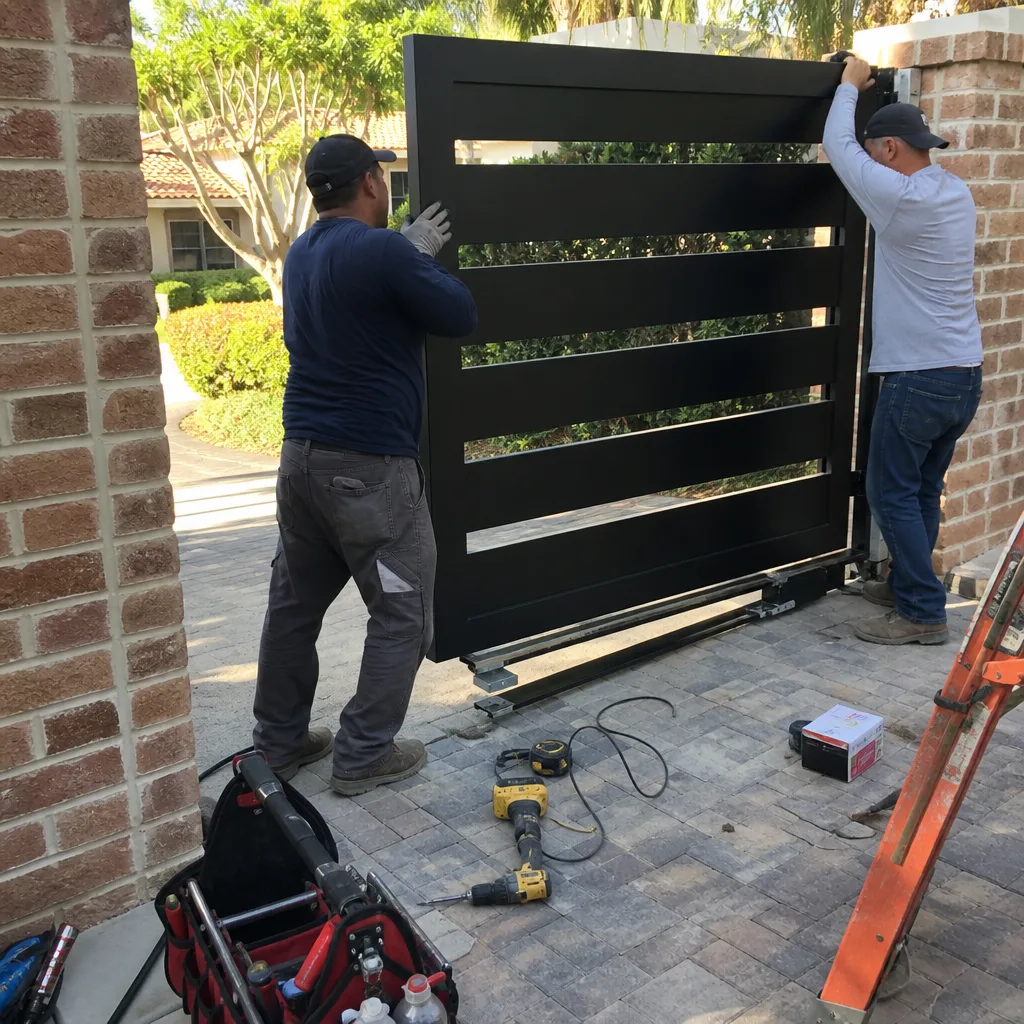
Nothing in gate maintenance pays off like a photograph taken six months ago. The human eye cannot track quarter-inch drift or gradual color changes, but a photo can. A seasonal photo log is the simplest, cheapest, most underused tool in the Boca Raton homeowner’s maintenance kit. It takes ten minutes per season, and it makes year-over-year drift visible in writing and images rather than in memory.
Here is the photo log protocol we recommend, and the one we follow on every gate installation in Boca Raton we complete:
- Take the same photos from the same angles every time. Consistency is what makes comparison possible. Stand in the same spot, hold the camera at the same height, frame the shot the same way. We recommend six standard shots: full gate closed from the street side, full gate open, hinge close-up on both sides, control board with the cover off, the area around the post bases, and the track or travel path for slide gates.
- Photograph the limit switch position after every adjustment. This is the single most valuable photo for diagnosing future problems. When the limit switch is set, photograph the mechanism so the position is visible. Six months later, compare. If the position has drifted, you know it before the gate misbehaves.
- Photograph the control board showing the LED indicators. Every brand has a specific LED pattern for normal operation. A photo of a healthy board is your baseline. When the gate acts up, a photo of the fault pattern next to your baseline photo gives a technician half the diagnosis before they arrive.
- Photograph any corrosion, however minor. A rust bloom the size of a dime this season will be the size of a quarter in six months. With photos, you can measure the rate of progression and decide when to intervene, not just that you need to.
- Label the photos with date and season. A phone camera stores the date, but a quick file name or album label makes retrieval easier. Create a folder called “Gate Log” and drop every seasonal pass into it. In two years, you’ll have a complete visual history of your gate’s health.
The photo log is also the foundation of the documentation standard we apply on every professional visit at Vance Gate Repair Boca Raton. Under Haven Standard Clause 4, every job includes a documented photo record of what was found, what was set, and what was installed. That record is left with the homeowner and filed in the job record. No future technician has to guess what a previous technician did, and no homeowner pays twice to rediscover the same problem. For a residential gate owner, the same principle applied with a phone camera costs nothing and prevents the slow, invisible drift that turns into repair bills.
Common Mistakes to Avoid
- Using a national four-season maintenance template. Boca Raton doesn’t have a fall or a spring in the sense those guides assume. Applying a northern maintenance calendar means you’ll be lubricating for a freeze that never comes and missing the salt-air corrosion window that actually matters.
- Ignoring irrigation overspray on gate posts. Sprinkler systems in Boca Raton communities like Boca Del Mar and Loggers’ Run hit gate columns daily with treated water. That mist dries and concentrates minerals, accelerating rust at the post bases. Adjust sprinkler heads to keep water off the gate, or plan for more frequent corrosion treatment on the lower 12 inches of the posts.
- Waiting for the gate to stop working before calling anyone. A gate that’s making a new noise, closing a little off-center, or running slower than last month is already telling you something is wrong. By the time the gate won’t open, the failure is usually more expensive. We see this pattern constantly in Boca Raton: the limit switch drifted for months, the motor burned itself out compensating, and a $180 adjustment became a $900 motor replacement.
- Tightening everything without a torque reference. Over-tightening a hinge bolt can be as damaging as leaving it loose. The bolt needs to be tight enough to hold without binding. Without a torque reference or at least a consistent feel, you can introduce new wear while trying to prevent it.
- Using interior-grade lubricants on exterior hardware. The humidity and salt air in Boca Raton will defeat a standard household lubricant in weeks. Use marine-grade or food-grade silicone lubricants rated for exterior, salt-exposed applications. The extra few dollars per can is dramatically cheaper than replacing a corroded hinge pin.
- Not documenting seasonal adjustments. Any adjustment made without a photograph is an adjustment lost to memory. Six months later, you won’t remember if you moved the limit switch or by how much. The photo log is the difference between knowing your gate’s history and guessing at it.
- Treating the gate as a static object. A gate is a machine that moves, and every moving machine drifts. The gate you installed five years ago is not the same gate today. Its metal has expanded and contracted hundreds of times, its software has been reset by power surges, and its hardware has worn. Treating it as fixed in place is how small problems become expensive breakdowns.
When to Call a Professional
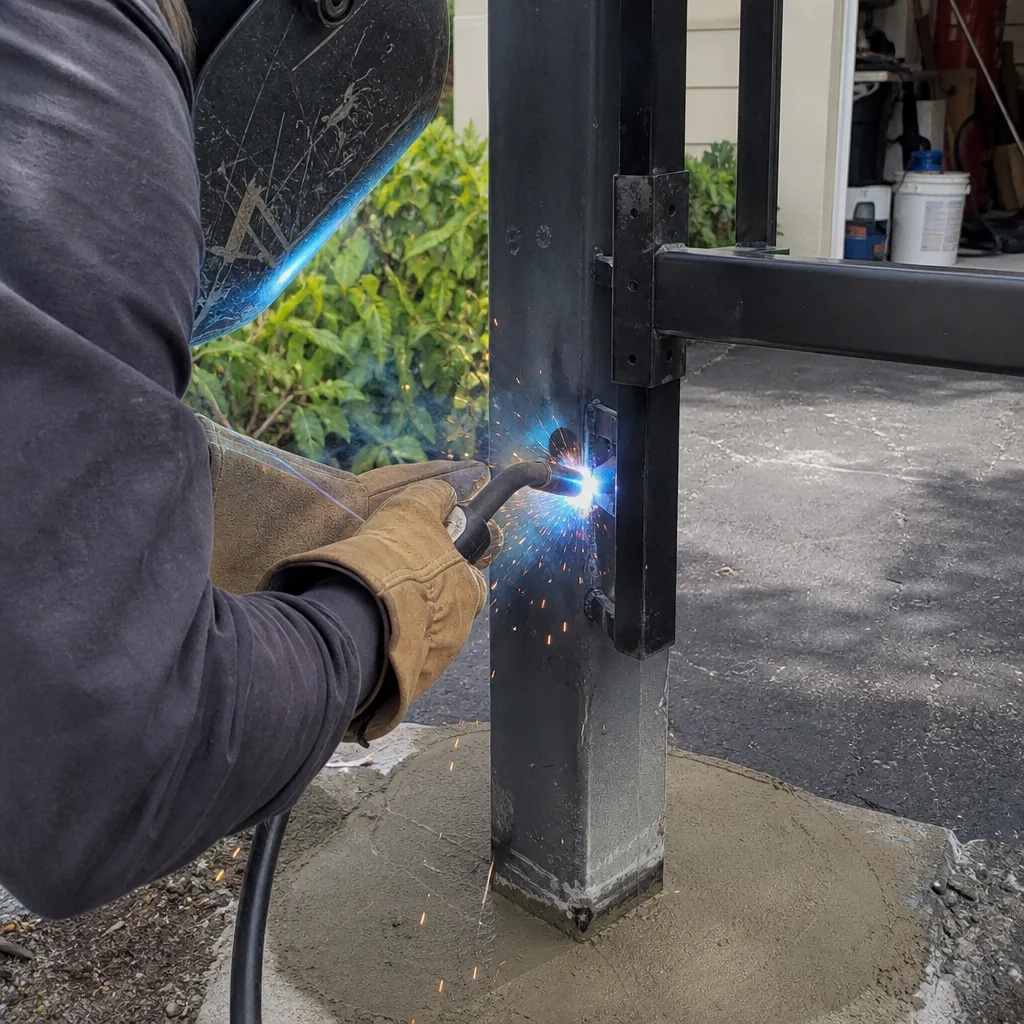
Some seasonal maintenance tasks are homeowner-friendly: taking photos, checking for visible rust, wiping down corroded terminals with contact cleaner, and confirming the gate still opens and closes fully. Other tasks are not. If the gate’s limit switch needs recalibration and you’re not confident in reading the operator’s programming menu, call someone who is. If the control board is showing fault codes you don’t understand, diagnosis by guesswork gets expensive. If the gate has a cracked weld, a sagging hinge, or a post that’s shifting in its footing, that’s structural work. If you smell burning electronics near the motor, disconnect power and call immediately.
Vance Gate Repair Boca Raton offers free estimates on all gate work in Boca Raton. Call (754) 666-7602 and a live person answers, day or night. The price is written down before anyone picks up a tool, and every visit ends with a photo record in your hand.
Frequently Asked Questions
Twice a year, ideally in April or May and again in November. The wet-season pass hardens the gate against humidity, rain, and salt air, while the dry-season pass recalibrates limit switches and drive tension after the metal contracts. A gate in Boca Raton’s coastal neighborhoods may need additional corrosion inspections every six months on top of those two main service visits. If you’d like a professional seasonal pass, call (754) 666-7602 for a written estimate.
A seasonal inspection and recalibration visit on a residential gate in Boca Raton typically runs between $120 and $280, depending on whether the gate is swing or slide, how many safety devices are installed, and whether any minor parts like fasteners or terminal blocks need replacement. Additional work like a motor replacement or weld repair is quoted separately, in writing, before any work begins. Call (754) 666-7602 for your exact price.
Yes, for the inspection, photo documentation, light cleaning, and visual checks. The wet-season and dry-season protocols in this guide are designed to be homeowner-friendly. However, limit switch recalibration, control board diagnosis, and any structural or electrical work is better left to a trained professional. High-voltage and pinch-point hazards on gate automation are real, and a misaligned safety edge is a genuine injury risk if handled incorrectly.
Thermal expansion and contraction. The aluminum or steel frame expands in the humid heat of summer and contracts in the cooler, drier winter months. This changes the gate’s travel distance, affects chain tension, and shifts the limit switch calibration. It’s normal for a Boca Raton gate to need recalibration twice a year. What’s not normal is letting it go so long that the motor wears out compensating for the drift.
Within one mile of the ocean in Boca Raton, a standard residential gate with coated steel hardware will corrode noticeably faster than one inland. This doesn’t mean you can’t have a gate; it means the hardware selection and the maintenance schedule have to match the environment. Stainless and marine-grade fasteners, sealed terminal connections, and more frequent inspection all become standard practice. Our team at Vance Gate Repair Boca Raton has installed and maintained gates along the Intracoastal since 2014, and we spec hardware accordingly.
Run the storm triage sequence in order: check the control board for fault codes, test the limit switch travel, verify the photo-eye and safety edge operation, check the anchor bolts, and inspect chain or belt tension. This takes about twenty minutes and catches most storm-related issues before they cause a gate outage. If you find anything out of the ordinary, call (754) 666-7602; a live person answers 24/7, and we can walk you through a diagnosis over the phone before anyone is dispatched.
The Bottom Line
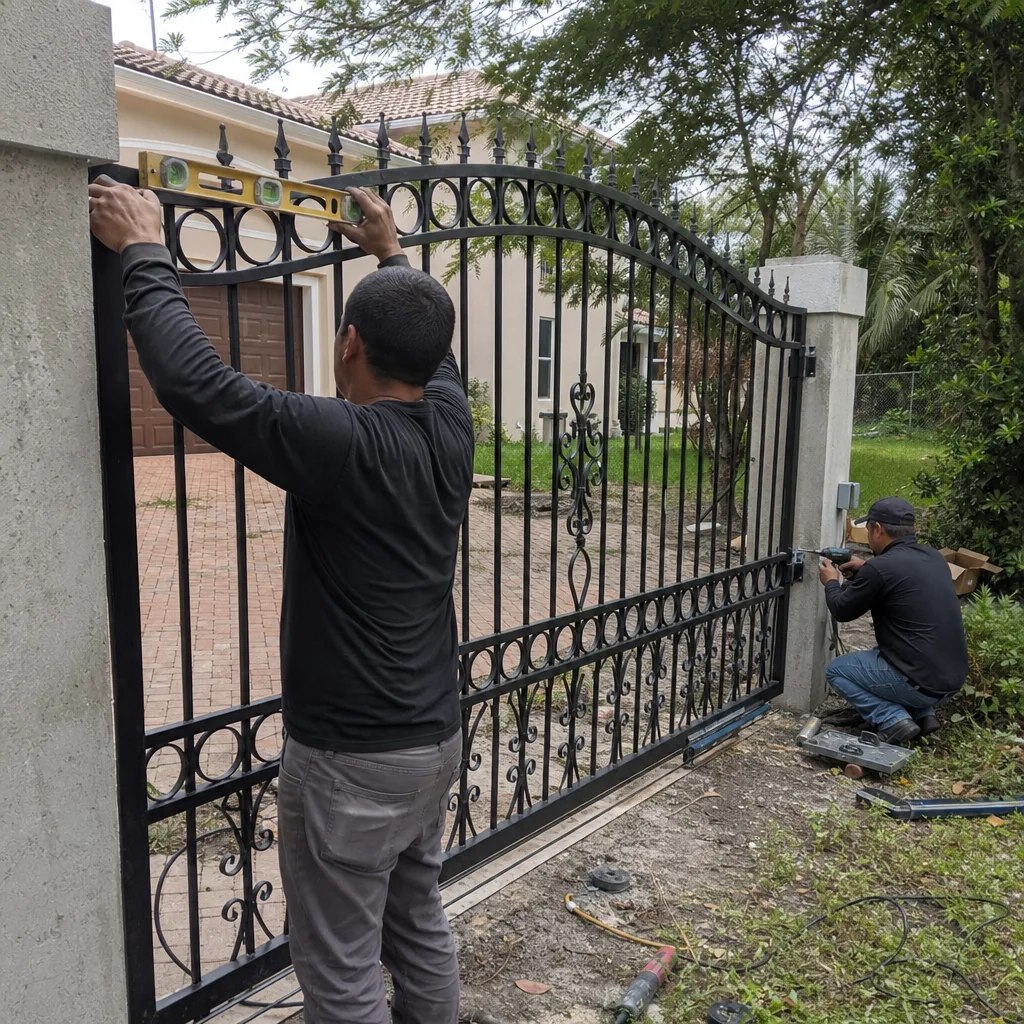
Boca Raton gate care is a two-cycle discipline. April and May are for hardening: treat corrosion points, confirm drainage, inspect fasteners, and document baseline positions before the humidity peaks. November and December are for recalibration: reset limit switches, retension chains, and check the contraction damage that dry-season cooling exposes. Between those two passes, the salt-air corrosion calendar runs on its own schedule, and the photo log you keep makes the slow changes visible. Most expensive gate repairs in Boca Raton start as cheap, visible, preventable problems. Browse our more guides & resources to stay ahead of seasonal maintenance. The homeowner who sees the drift early, with photos in hand and a written record of adjustments, pays for maintenance instead of emergencies. For a professional seasonal pass or a free estimate on any gate work, call Vance Gate Repair Boca Raton at (754) 666-7602. A live person answers, and the price is always in writing before work begins.
Written by Adrian Vance, Owner at Vance Gate Repair Boca Raton, serving Boca Raton since 2014.