
Last updated September 20, 2026
Free on-site gate assessment - hinges, posts, and your LiftMaster or Nice gate operator checked before anything is quoted
The assessment is free and the quote is the invoice.

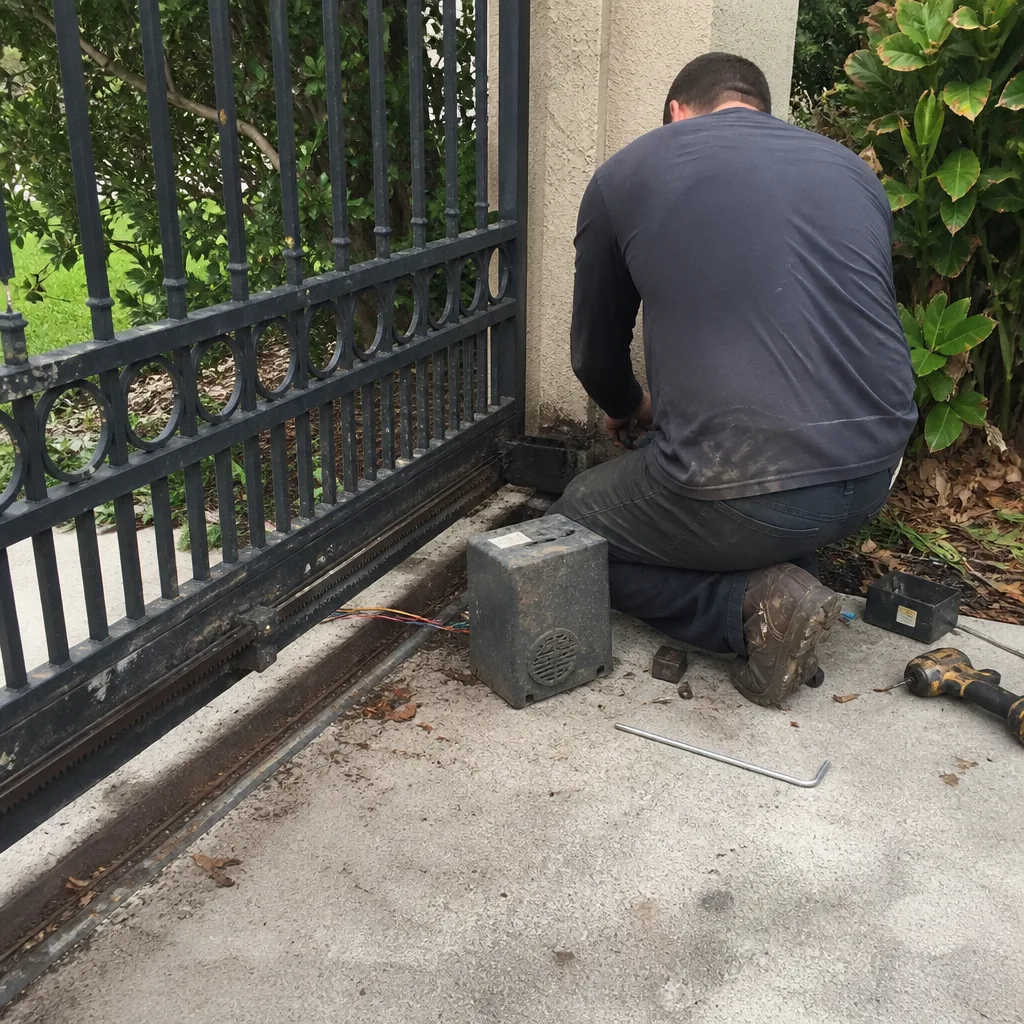 Before
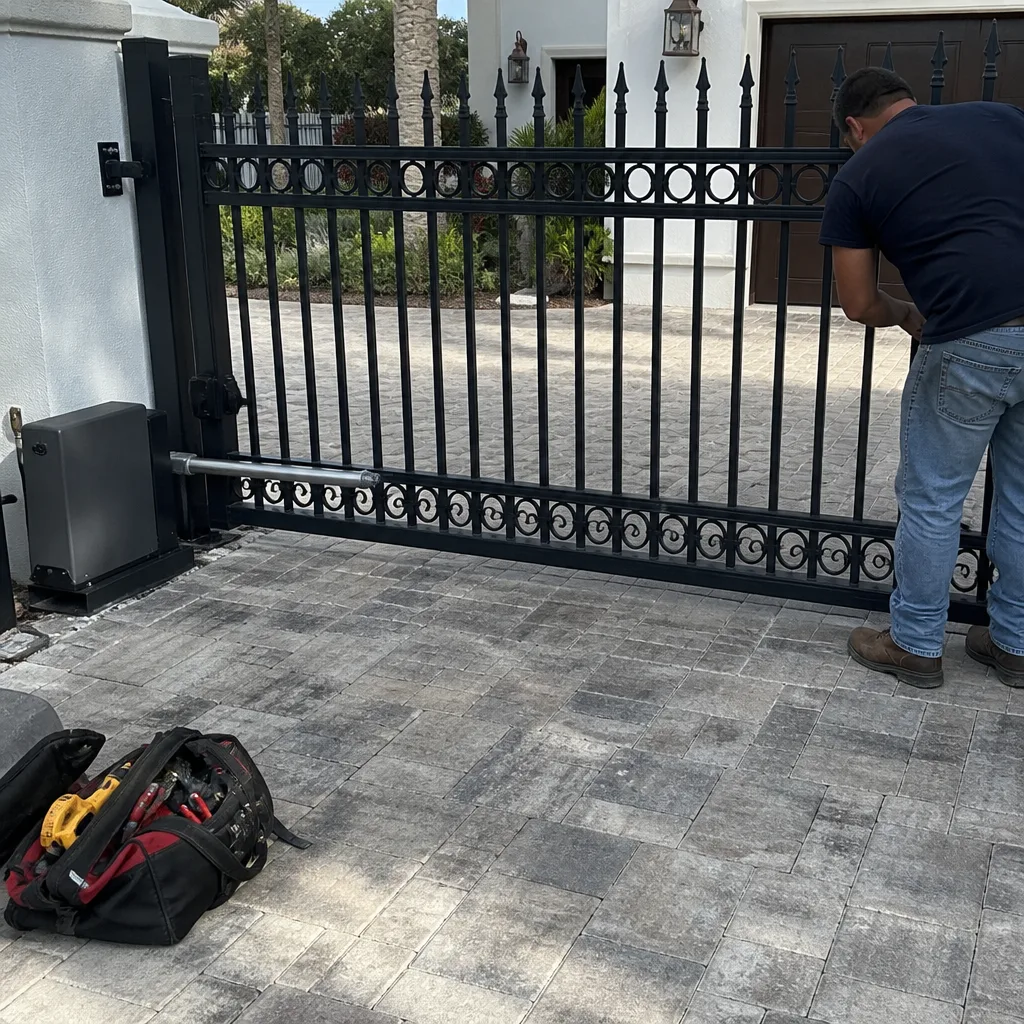 After
After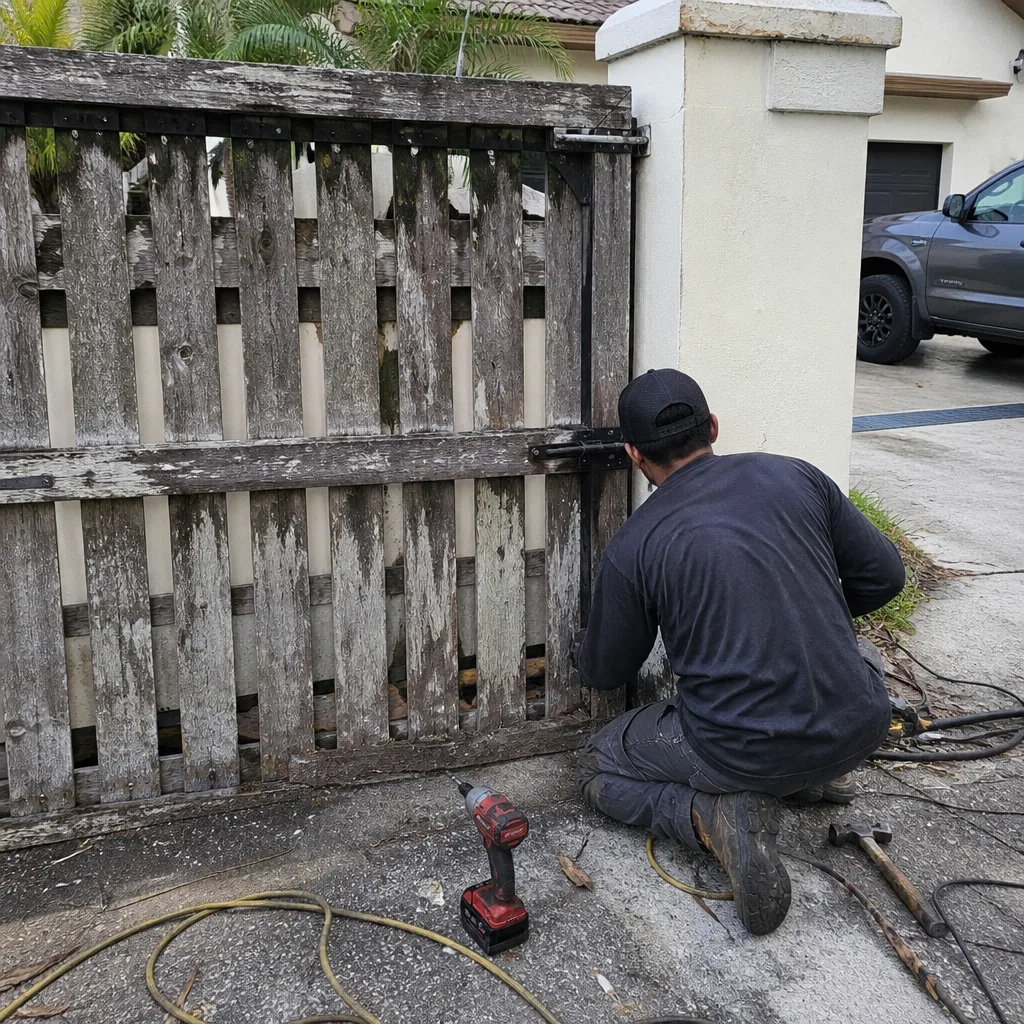 Before
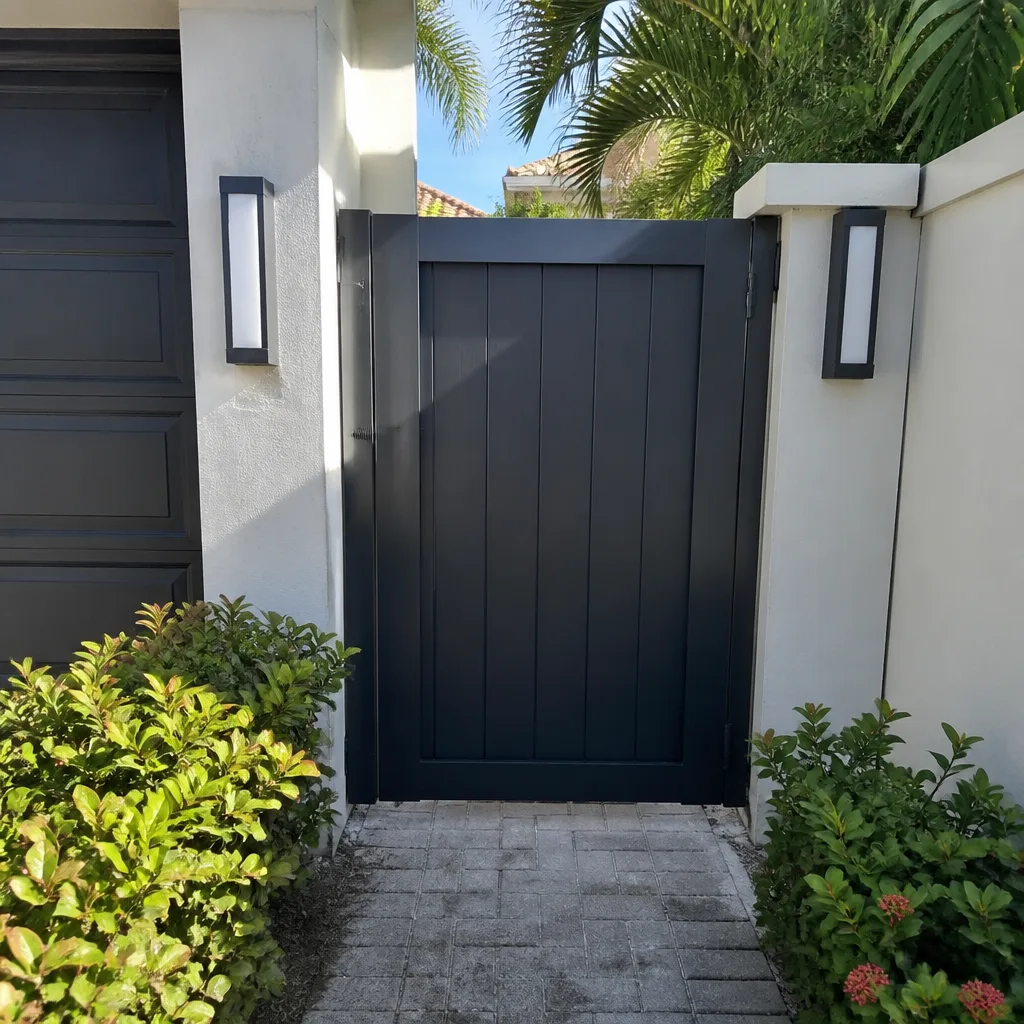 After
After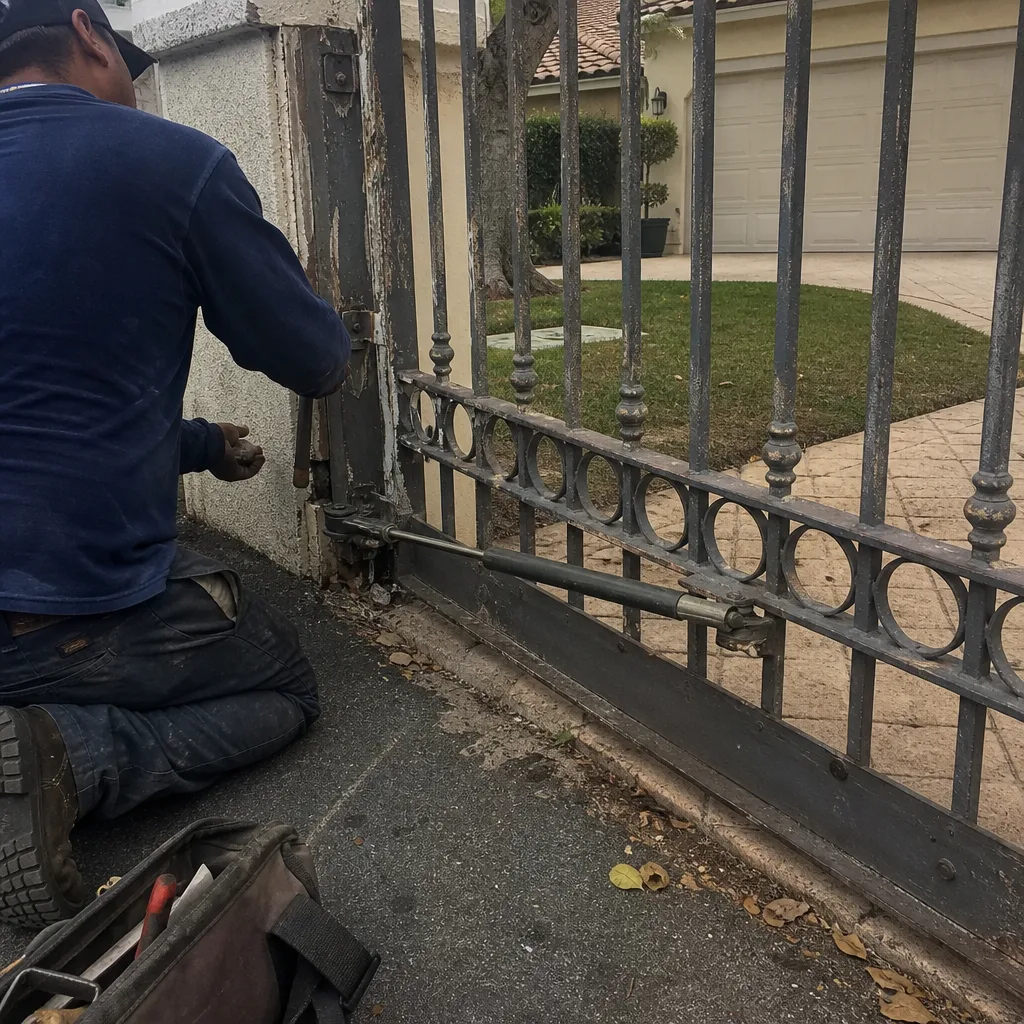 Before
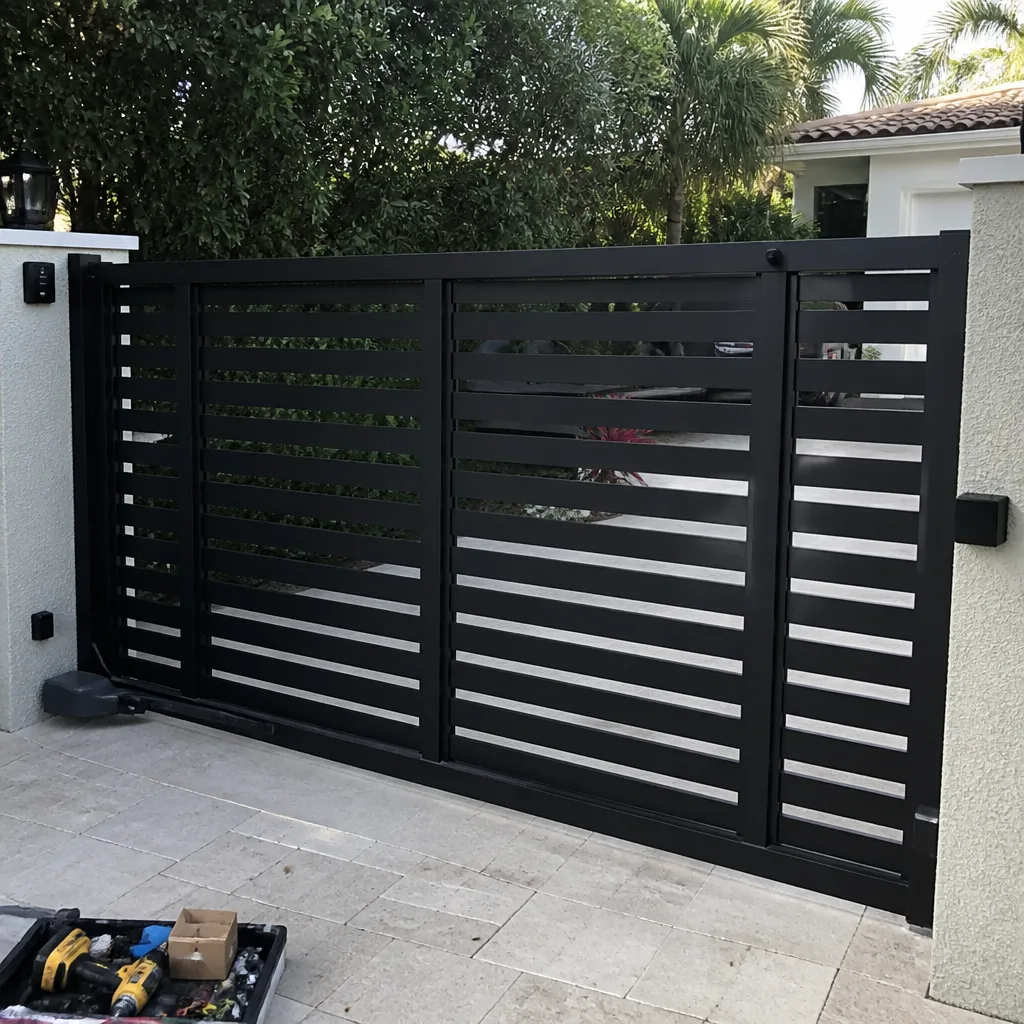 After
AfterGate Repair Warning Signs: A Boca Raton Homeowner’s Reference Guide
The most expensive gate failures don’t announce themselves. They accumulate in half-second delays, a faint scrape on the track, a sensor that faults once a month and then works fine for three weeks. Homeowners in Boca Raton explain these things away for six months, and then a Saturday morning arrives where the gate won’t open at all and the repair bill is triple what an early catch would have cost. This guide names what each symptom actually points to, so you can report findings instead of guesses. We’ve repaired and installed over 22,000 gates since 2014, and the pattern is consistent: the gates that fail catastrophically are almost always the ones whose owners dismissed the quiet warnings for months. If you’re noticing early symptoms, our Gate Repair services can catch problems before they escalate.
Quick Answer
A gate that moves more slowly than it did last month, hesitates before reversing, makes a new scraping or grinding sound, or trips a sensor fault more than once in a week is telling you something specific. Most warning signs in Boca Raton point to one of three root causes: motor capacitor degradation, limit-switch drift, or wiring corrosion accelerated by humidity and salt air. None of these fix themselves, and all of them get more expensive the longer they’re ignored.
Table of Contents
- Eight Observable Symptoms and What They Actually Mean
- How to Time Your Gate’s Open/Close Cycle (And Why Two Seconds Matter)
- Intermittent vs. Progressive Faults: Why the Repair Approach Differs
- Boca Raton’s Fire Ant Problem: When It Looks Electrical But Isn’t
- How to Photograph and Describe a Warning Sign for Remote Diagnosis
- Salt Air and Humidity: The Boca Raton Corrosion Pattern
- What Your Gate Opener Brand Tells You About the Likely Fault
- When to Call a Professional
- Frequently Asked Questions
BeforeAfterEight Observable Symptoms and What They Actually Mean
Every gate failure leaves evidence before the final breakdown. Here are the eight warning signs we see most often on residential driveway gates across Boca Raton, mapped to the root cause each one most commonly indicates. These aren’t hedges, they’re patterns built from thousands of service records.
- Gate moves noticeably slower than it did three months ago. This is the most commonly ignored warning sign. A slowing gate almost always points to a motor capacitor losing its charge capacity. Capacitors are wear items with a lifespan of roughly five to eight years in Boca Raton’s heat. When they degrade, the motor draws more current to do the same work, which accelerates motor wear. The capacitor is a cheap repair. The motor it takes down if ignored is not.
- Gate hesitates for a second or two before reversing direction, or stops halfway through travel. This points to limit-switch drift. Limit switches are the mechanical or magnetic stops that tell the opener where the gate’s travel ends. Over time, vibration and thermal expansion from Florida heat cause these settings to creep. A switch set 12 degrees past actual travel will make the opener hunt, stall, and eventually fault out.
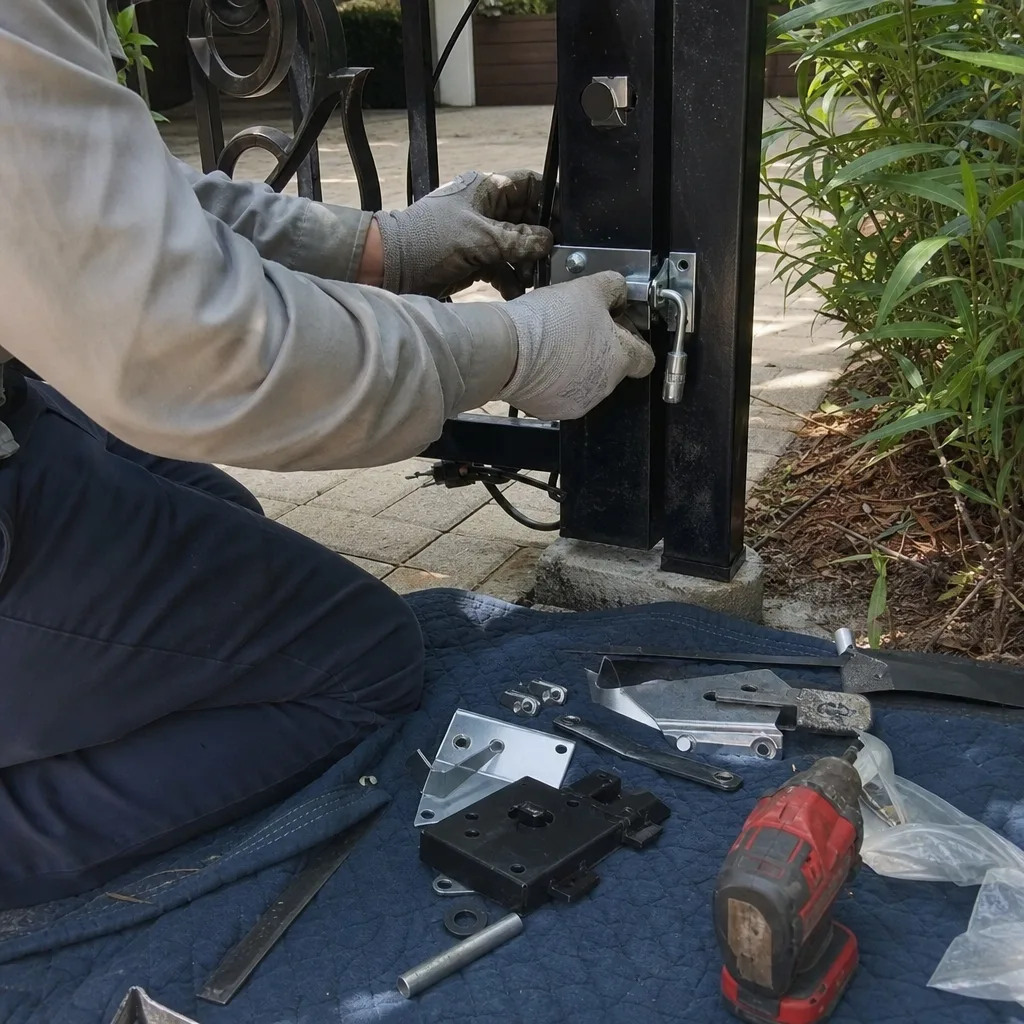
- A new scraping or grinding sound that wasn’t there before. Noise is almost always mechanical, not electrical. On slide gates, the likely culprit is worn rollers or a misaligned track caused by ground settling, which Boca Raton’s sandy soil does constantly. On swing gates, it’s typically hinge wear or a sagging gate leaf dragging across the driveway. Both get worse with every cycle.
- Gate reverses after closing an inch or two, or won’t close fully. The usual suspect is a misaligned photo-eye, the infrared beam that stops the gate if something crosses the path. In Boca Raton, we regularly find photo-eyes knocked out of alignment by landscape crews with string trimmers, or lens faces fogged by humidity. A two-inch beam misalignment will cause exactly this behavior.
- The opener hums but the gate doesn’t move. That hum is the motor straining against something. On slide gates, it’s typically a seized roller or debris packed into the track. On swing gates, it’s often a gearbox that’s stripped internally. Continued attempts to cycle the gate while it’s binding will burn out the motor. This one deserves a call the same day.
- Remote works from twenty feet but not from fifty, or only works sometimes. Decreasing remote range is often an antenna or receiver issue, but in Boca Raton it’s frequently something else: a corroded terminal on the receiver board, or a failing capacitor in the remote itself. If both remotes degrade at the same rate, the problem is at the opener, not in your pocket.
- The gate beeps or faults intermittently, then works fine for days. Intermittent faults that come and go without a pattern are the signature of a wiring problem, not a mechanical one. A crushed wire jacket, a loose terminal screw, a splice that’s green with corrosion. These are the hardest to diagnose without methodical testing, and they’re also the ones most likely to strand you at the exact wrong moment.
- Visible rust, sag, or leaning on any gate component. Steel and wrought iron in Palm Beach County fight a constant battle against salt air and humidity. A gate leaf that leans two degrees today will lean five degrees in a year. The hinges and posts carry the load, and when they fail, the gate doesn’t just sag, it falls. This is one of the few warning signs you can see from the driver’s seat. Don’t look away from it.
How to Time Your Gate’s Open/Close Cycle (And Why Two Seconds Matter)
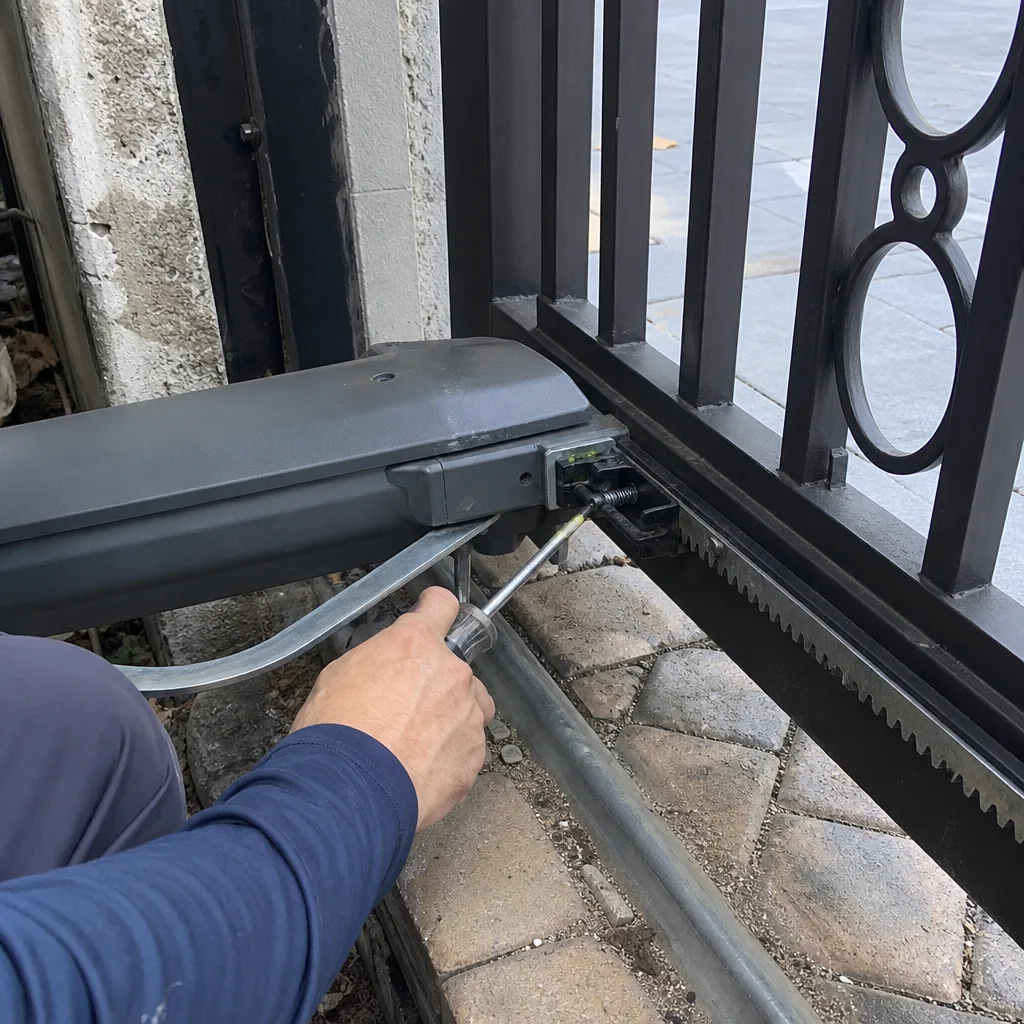
Most gate openers are specified to complete a full open or close cycle in a certain number of seconds, typically between 12 and 18 seconds for a residential swing gate depending on leaf length, and 15 to 25 seconds for a slide gate depending on track length and motor horsepower. That spec isn’t arbitrary. The motor, gearbox, and control board are all sized around a specific load profile. When the cycle time creeps up, the entire system is working harder than it was designed to.
Here’s how to establish your baseline and track it:
- Time your gate’s full open cycle three times today. Use the stopwatch on your phone. Do it in the late afternoon when the metal has been in the sun all day; heat changes how everything moves, and you want the worst-case number.
- Write the three times down. Average them. That’s your baseline. If your gate opens in 14 seconds on average today, that’s the number.
- Re-time it once a month, in the same conditions. Late afternoon, gate closed and resting for at least an hour, same time of day. Write each month’s average next to the last.
- Note any deviation of more than two seconds from the original baseline. That’s the operational threshold where something measurable has changed. It is not your imagination.
A swing-gate motor that used to finish its cycle in 14 seconds and now takes 17 seconds has lost roughly 20 percent of its effective performance. That’s not a subtle drift; that’s a component degrading. The most common cause is capacitor aging, followed by gearbox wear. Both are repairable, and both cost a fraction of what a full motor replacement runs. But only if they’re caught while the gate still opens at all.
In Boca Raton specifically, we see seasonal variation in cycle times. Gates run slightly slower in August because thermal expansion adds friction at the hinge and roller points. A one-second summer slowdown is normal. What’s not normal is when the slowdown persists into November and the gate doesn’t return to its winter baseline. Persistent slowdown means wear, not weather. For a complete maintenance calendar, read Seasonal Gate Repair Care for Boca Raton: Year-Round Homeowner’s Guide.
Intermittent vs. Progressive Faults: Why the Repair Approach Differs
Warning signs fall into two families, and they are repaired differently. Understanding which family your symptom belongs to changes how urgent the repair is, what it will likely cost, and how a good technician will approach it. For a deeper look at what to expect when hiring help, see our guide on How to Hire a Gate Repair Contractor in Boca Raton: A Step-by-Step Guide.
Progressive faults are mechanical. They get worse with every cycle. A grinding roller gets louder. A sagging gate gets lower. A worn hinge gets looser. The pattern is linear and predictable. You can graph it. Progressive faults are caused by physical wear: metal moving against metal, bearings losing lubrication, components carrying loads they were never sized for. The repair approach is mechanical: replace the worn part, re-lubricate the assembly, realign the load path. Progressive faults left alone don’t just get more expensive, they cause collateral damage. A worn roller on a slide gate will eventually devour the track it rides on, and the track is not a cheap part.
Intermittent faults are electrical or sensor-based. They appear and vanish. The gate faults on Tuesday, works Wednesday, faults again Saturday morning. There’s no wear pattern because the problem isn’t friction. It’s a connection, a component, or a signal that’s failing under specific conditions. Boca Raton’s environment makes intermittent faults more common here than in drier climates: humidity corrodes terminal screws, salt air attacks wire jackets, and afternoon thunderstorms create condensation cycles inside control boxes that weren’t sealed properly.
The repair approach for an intermittent fault is diagnostic, not mechanical. You don’t replace parts by gut feel. You meter the circuit, load-test the capacitor, exercise the wiring harness, and document the readings. This is where commercial-grade documentation habits pay off on residential jobs. Adrian Vance spent years on commercial access-control sites before founding Vance Gate Repair in 2014, and the habit that carried over is this: measure everything, write it down, photograph it, and never make the homeowner pay twice to rediscover the same problem. If a technician replaces a control board on a gate with a wiring fault, the new board will fault within a month, and the homeowner gets a second invoice. That’s exactly what a systematic diagnostic approach prevents.
Boca Raton’s Fire Ant Problem: When It Looks Electrical But Isn’t
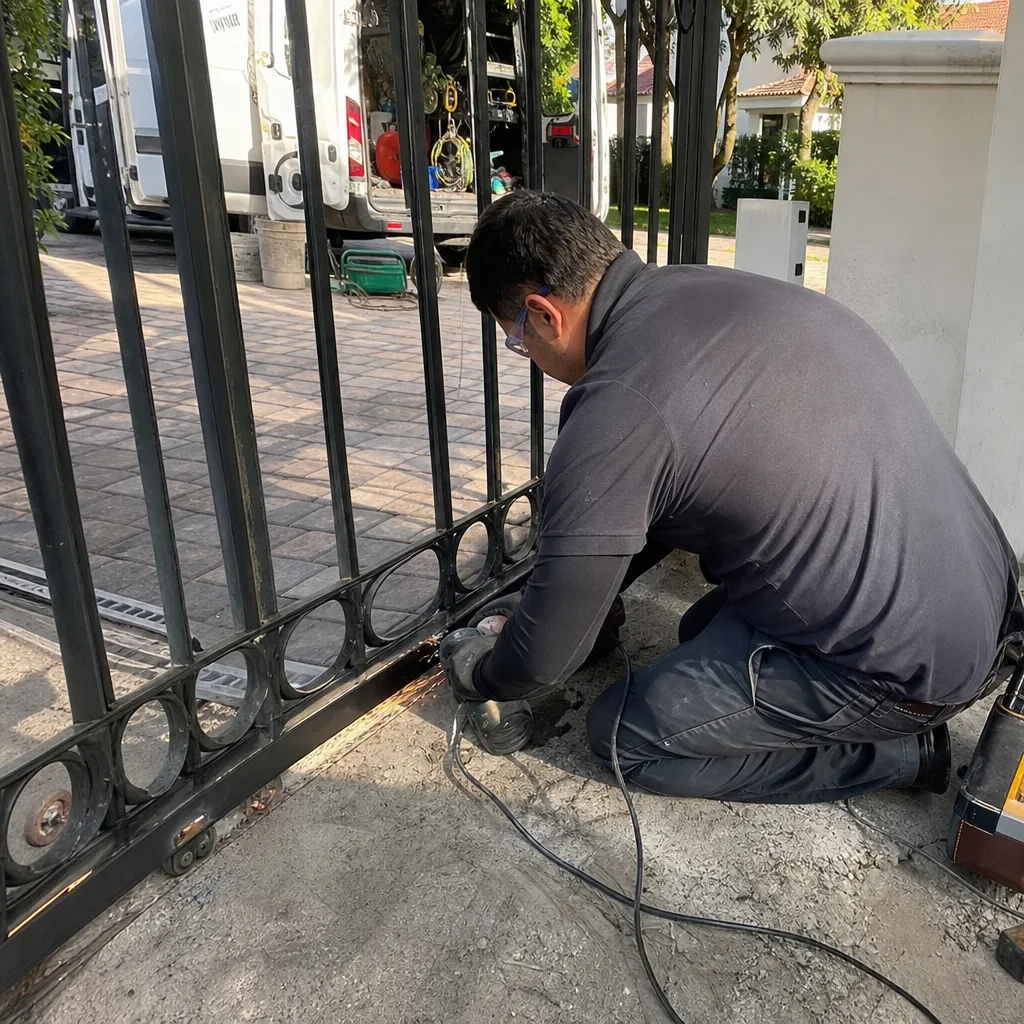
If you live in Boca Raton, you already know about fire ants. What most homeowners don’t know is that fire ants are drawn to the inside of gate opener control boxes, and the damage they cause mimics electrical failure so closely that even experienced technicians have misdiagnosed it.
Fire ants are attracted to the warmth and electromagnetic field of control boards. They swarm inside the housing, build nests, and then get electrocuted by contact with the board terminals. Their bodies create a conductive paste that bridges across circuits, causing shorts that appear randomly, faults that come and go, and behavior that looks exactly like a failing board. This is not a rural problem. Communities across Boca Raton, from gated developments in Woodfield Country Club to estates along the Intracoastal, deal with this every year.
Here’s the pattern to look for. If your gate starts faulting intermittently after a period of heavy rain, and the fault is new within the last two weeks, check the control box for ant activity before assuming the board is bad. If you see the telltale dirt trail leading into the housing, or if you open the box and find the remains of a nest, that’s likely the source of the fault, not the board itself. The fix is cleaning the board with the correct electrical contact cleaner, sealing the enclosure entry points, and placing ant deterrent around the mounting surface, after the power is safely off and the job is done by someone trained to work around line voltage.
The reason this matters for your wallet: a homeowner who doesn’t know about ant intrusion will often replace a perfectly good control board, pay for a new one, and then have the problem return when the ants come back. That’s a repair that should cost a service call and an hour of labor, not a board replacement. We document ant damage with photos on every visit and leave the homeowner with a written record of exactly what was cleaned and sealed.
How to Photograph and Describe a Warning Sign for Remote Diagnosis
A well-documented warning sign saves billable diagnostic time, and in some cases allows a technician to arrive with the right part already on the truck. Here’s how to photograph and describe what you’re seeing so a gate professional can diagnose it remotely before rolling a truck.
Photograph the right things
- Wide shot of the entire gate from the driveway side. This shows the gate type, the opener brand, the hinge or track configuration, and the overall condition. One useful photo beats a hundred words.
- Close-up of the specific area where the symptom originates. If you hear a scrape, photograph the roller or hinge where the sound comes from. If the gate sags, photograph the hinge side at eye level, straight on.
- The control box with the cover open, if you can do it safely. This shows wire condition, corrosion, ant activity, and any visible board damage. Don’t touch anything inside; just photograph.
- The opener brand and model label. Most diagnostics start from knowing what motor you have. The label is usually on the side of the motor housing. LiftMaster, FAAC, BFT, Viking, DoorKing, Elite, Ghost Controls, and Mighty Mule all have different fault patterns.
- Video of the gate cycling, with audio. Sound is diagnostic. A scrape, a hum, a click, a grinding gear: these sounds point to different problems, and a short video captures them better than a description.
Describe it in measurements, not feelings
The single most useful thing you can tell us is a number. “The gate is slow” is a feeling. “The gate took 19 seconds to open today and it used to take 14” is a measurement. “The gate sags” is an impression. “The gate leaf is about two inches lower at the latch end than the hinge end” is a finding. When you report measurements, you hand the technician a diagnostic head start before they ever see the gate.
Mention environmental context too. Did the symptom start after a storm? After the lawn crew came through? After a power outage? These details matter. In Boca Raton, a fault that appears after a heavy downpour often points to water intrusion in a control box or a photo-eye housing, and that changes the likely fix before anyone even opens a tool bag.
Salt Air and Humidity: The Boca Raton Corrosion Pattern
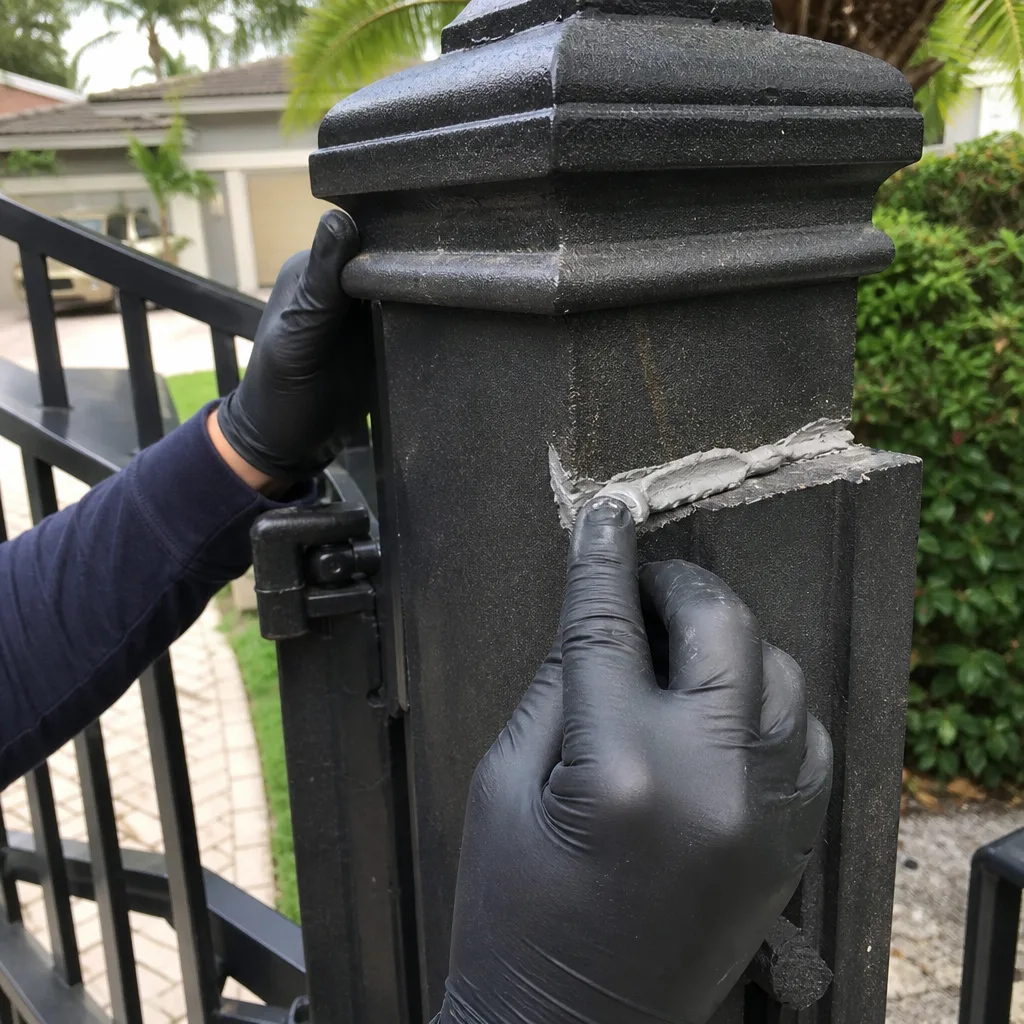
Boca Raton gates age differently than gates in Orlando or Dallas. The combination of Atlantic salt air, 90-percent humidity, and summer temperatures that push 95 degrees creates an environment that attacks every electrical connection and every unprotected steel surface.
The corrosion pattern we see repeatedly is not uniform. It concentrates in specific locations: terminal blocks inside the control box, splice points where landscape wiring meets gate wiring, hinge pin surfaces, and the bottom rail of hollow steel gate frames where condensation collects internally. A gate that looks structurally fine from ten feet away can have terminal screws that crumble when touched.
This is why a visual inspection is never sufficient on a Boca Raton gate. The failure points hide inside sealed boxes and under paint. They require a meter to find: a voltage drop test across a corroded connection, a resistance test on a wire run that’s been soaking in moisture underground. This is the documented approach we use on every service call, and it’s why the gate repair service we provide in Boca Raton spans the full diagnostic process, from photo to meter to written record.
The practical takeaway for a homeowner: if your gate is more than five years old and has never had its connections inspected, they have corrosion even if nothing has failed yet. An inspection now costs a service call. The failure it prevents when a corroded terminal finally lets go could be a full opener replacement, and in a worst case, a gate that falls off its hinges.
What Your Gate Opener Brand Tells You About the Likely Fault
Not all gate openers fail the same way. We service nine major automation brands, and over the years certain failure patterns have become consistent enough to be useful. If you know your opener brand, here’s what to watch for first.
Viking and DoorKing openers are common on heavier swing gates in Boca Raton’s larger properties. These are American-made, parts are available locally, and they tend to wear out gearboxes before they fail electronically. The warning sign to watch is a slower cycle time with a consistent mechanical noise, a low grumble, that gets worse under load. That’s gearbox wear. The electronics are usually fine.
Ghost Controls and Elite are popular on residential slide gates and lighter swing gates. These units are more electronic in their failure modes: limit-switch drift, photo-eye sensitivity changes, and remote-receiver issues. The warning pattern is intermittent, not progressive. A fault that appears every few cycles, or a remote that works sporadically, points here.
FAAC and BFT, the Italian hydraulic and electromechanical brands, are common on higher-end properties in communities like Royal Palm Yacht & Country Club and The Sanctuary. These systems are engineered tightly and respond badly to neglect. A hydraulic FAAC that leaks fluid or runs low will cycle slower and eventually damage its own pump. The warning sign is oil staining on the ram or the ground beneath it. That’s a same-week repair, not a next-season repair.
LiftMaster and Linear appear on a wide range of mid-market installations. Their failure pattern is broad, but the most common warning sign we see in Boca Raton is capacitor degradation from heat exposure. These units sit in direct sun all day in South Florida, and capacitors have a rated temperature range that gets exceeded regularly. A slow gate with an occasional hum at startup is the classic signature.
Mighty Mule is the DIY-friendly brand, and the warning signs usually relate to installation quality: wire splices done without sealed connectors, control boxes mounted where they get soaked by sprinklers, and photo-eyes mounted where foliage moves in the wind. If you have a Mighty Mule, check the wiring first, especially splices and the battery connection.
The point of knowing your brand is not to diagnose it yourself. It’s to describe what you’re seeing in the vocabulary a technician can use. “Ghost Controls opener with intermittent remote faults and one photo-eye that occasionally blinks off” is a complete diagnostic brief. If you’re not sure what brand you have, photograph the label and start from there. For broader context on what’s involved in opener work, see our gate motor and opener service page.
When to Call a Professional
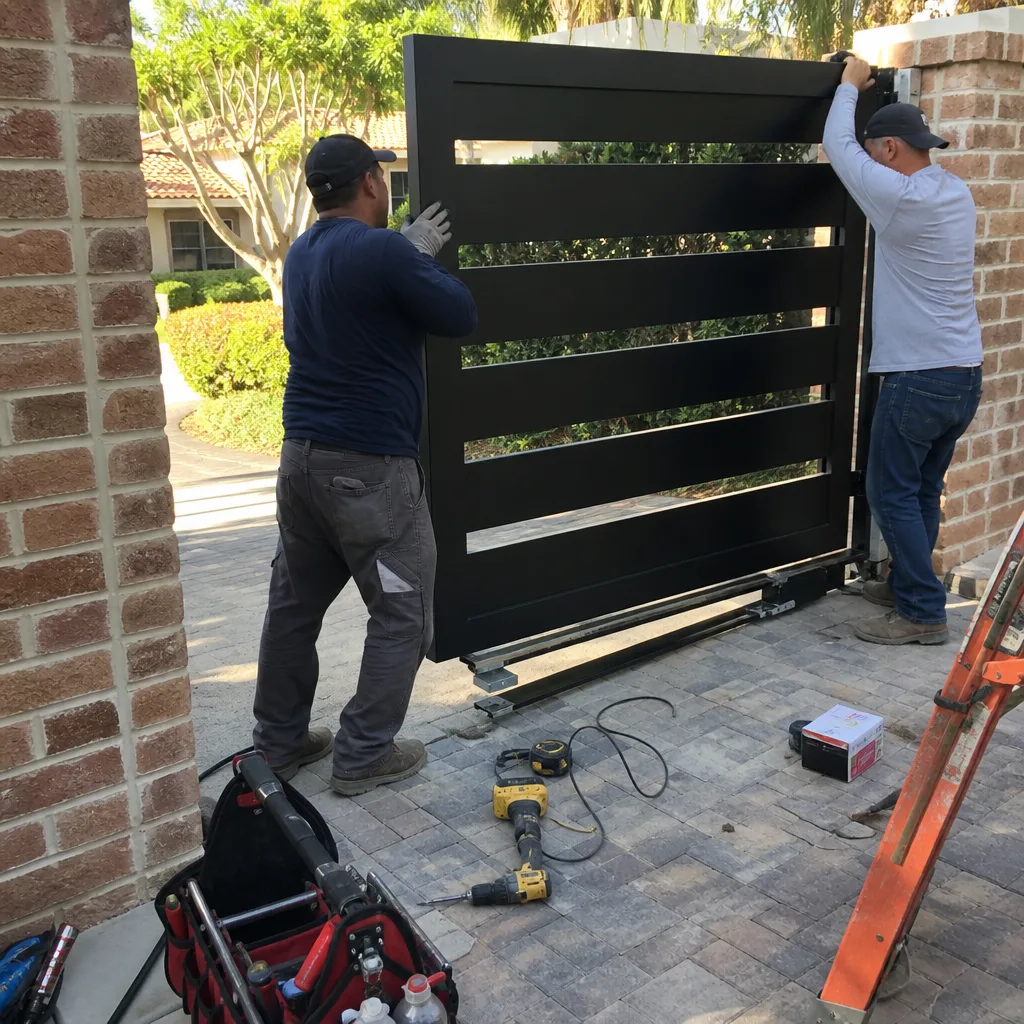
Some warning signs justify a careful watch-and-wait. Others don’t. Call a professional the same day if your gate hums without moving, faults repeatedly while cycling, shows visible damage to hinges or posts, or makes a grinding noise that gets worse with each use. These are failure-in-progress states, and continuing to cycle the gate will expand the damage. Call within the week if you’ve measured a cycle-time slowdown of more than two seconds, noticed corrosion on terminals or structural steel, or seen ant activity in the control box. These are not emergencies, but they become more expensive on a schedule you don’t control. Vance Gate Repair’s Boca Raton team responds quickly to gate failures and provides a written price before any work begins. For a free estimate, call (754) 666-7602.
Common Mistakes to Avoid
- Ignoring a slowdown because “it still works.” A gate that still works while degrading is the cheapest version of that gate you’ll ever repair. The slowdown is the diagnostic window, and it doesn’t stay open forever.
- Cycling the gate repeatedly to “reset” a fault. Every cycle with an unresolved fault is another load on a component that’s already failing. If it faulted once, call or inspect. If it faulted twice in one day, stop using it.
- Spraying WD-40 on hinges and rollers. WD-40 displaces water, which is useful, but it also strips existing grease and leaves surfaces drier than they were. Use the correct lithium or PTFE lubricant for gate hardware, or let a technician do it.
- Ignoring ant trails near the control box. In Boca Raton, that dirt trail is not just a landscaping detail. It’s the early stage of a control-board failure that looks electrical and gets misdiagnosed.
- Patching over rust without addressing the cause. Painting over a rusted hinge or post means the rust continues underneath. The rust you can see on the outside is usually only a fraction of what’s happening inside the joint or tube.
- Replacing the battery in one remote and ignoring the other. If one remote is failing, it might be the remote. If both are failing, it’s almost certainly the receiver or antenna, and a new battery won’t touch it.
- Assuming a new gate won’t have problems. Even a proper gate installation in Boca Raton requires adjustment after the first few months as the ground settles and the metal seasons. The break-in period is real, and skipping the follow-up inspection means catching small drift after it becomes visible damage.
Frequently Asked Questions
Most residential gate repairs in Boca Raton run between $185 and $650 depending on the fault. A photo-eye realignment or limit-switch reset on a slide gate typically lands near the lower end, while a capacitor replacement or control-board service runs higher. Gearbox and motor replacements start around $780 and go up from there depending on the brand and gate size. Every repair we perform at Vance Gate Repair carries a written price handed over before the work starts, and estimates are always free. Call (754) 666-7602 for an exact quote.
For active failures where the gate is stuck, binding, or faulting continuously, same-day response in Boca Raton is realistic. A gate that has failed completely or is unsafe to leave open gets priority scheduling, and a live person answers our calls 24/7 to get a technician dispatched, no voicemail loop. For non-emergency work, we schedule the visit at a time that works for you and confirm the technician’s name and photo before they arrive.
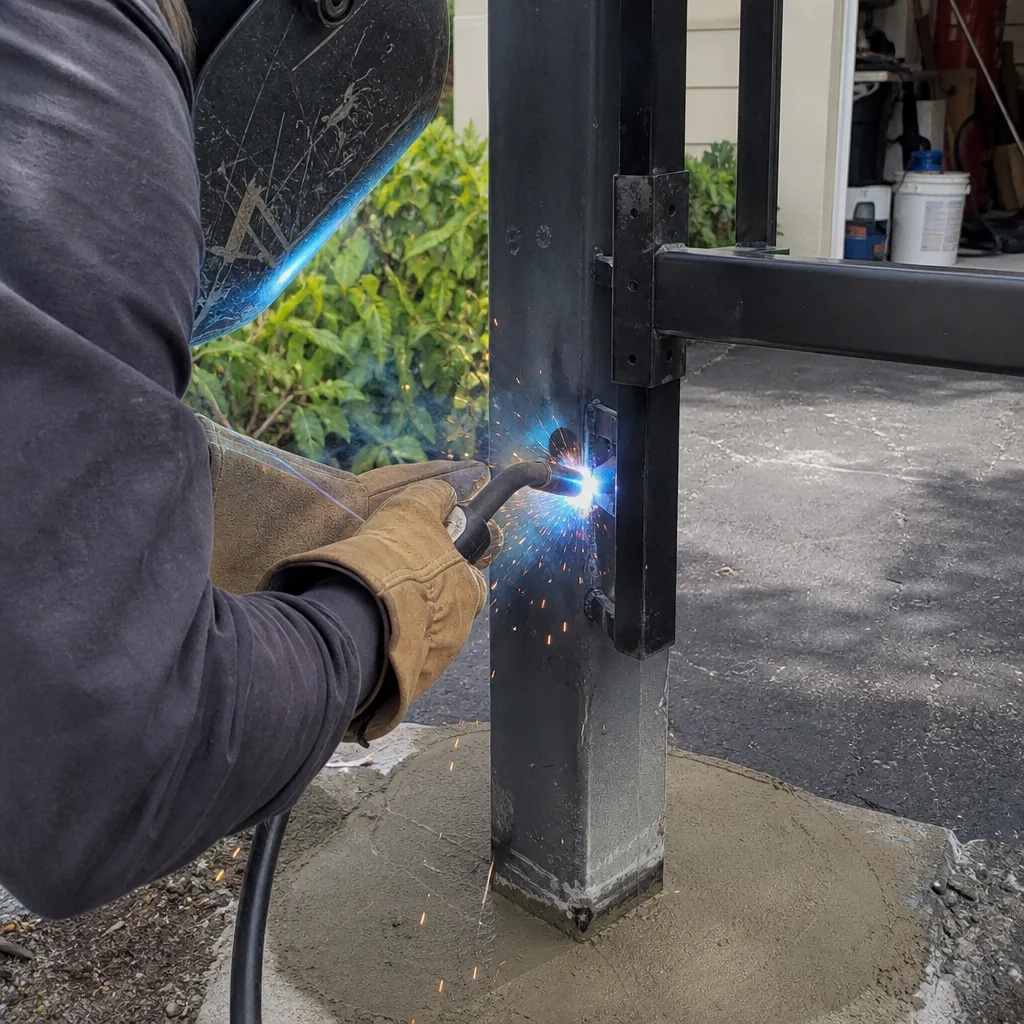
A full gate installation in Boca Raton includes the gate frame or panel fabrication, posts and hinges, the opener motor and arm, photo-eye safety sensors, the power run from your electrical panel to the gate location, and final limit-switch setup. Depending on the property, it may also include keypad entry, vehicle exit sensors, and battery backup. Every installation we quote includes a complete written scope with line-item pricing, so you know exactly what’s in the job before work begins.
Yes. We run the electrical service to the gate, install the safety edges and photo-eyes, and wire the entire system as a complete job. We don’t sub out the electrical work or leave you coordinating between a gate company and an electrician. The power run and the safety devices are part of the installed system, documented in the written quote, and photographed in the final record.
In our experience, a quality gate opener in Boca Raton lasts 7 to 12 years with proper maintenance. The limiting factor in this climate is not mechanical wear so much as heat and corrosion: capacitors that cook in summer temperatures, terminal screws that oxidize in the humidity, and control boards that fail from ant intrusion. An opener that gets a yearly inspection and has its connections cleaned and tightened will reliably outlast an identical opener that’s left untouched from installation day.
A warranty is only as good as the terms you can actually enforce, and the most important term is the duration. Every repair completed by Vance Gate Repair is covered by the 365-Day Done Right Promise: if the repair is not right within one full year, we make it right at no additional charge. That covers parts and labor, with no argument and no fine print about exclusions buried in the back of the invoice. Ask any gate company the exact duration of their warranty before you hire them, and get it in writing.
The Bottom Line
Gate warning signs are measurements, not moods. A two-second slowdown, a 12-degree limit-switch drift, a monthly photo-eye fault, an ant trail leading into the control box: each of these is a specific finding with a specific fix, and each is cheaper to address this week than it will be in six months. Boca Raton’s climate accelerates every degradation curve, from salt-air corrosion to heat-stressed capacitors, which means the watch-and-wait approach costs more here than almost anywhere else. The gate that worries you today is the gate you’ll want fixed tomorrow. The right approach is one that starts with a written price, ends with a documented record, and makes the numbers visible before, not after, the work is done. For more guides & resources on keeping your gate reliable, visit our blog.
Written by Adrian Vance, Owner at Vance Gate Repair Boca Raton, serving Boca Raton since 2014.