
Last updated September 20, 2026
Free on-site gate assessment - hinges, posts, and your LiftMaster or Nice gate operator checked before anything is quoted
The assessment is free and the quote is the invoice.

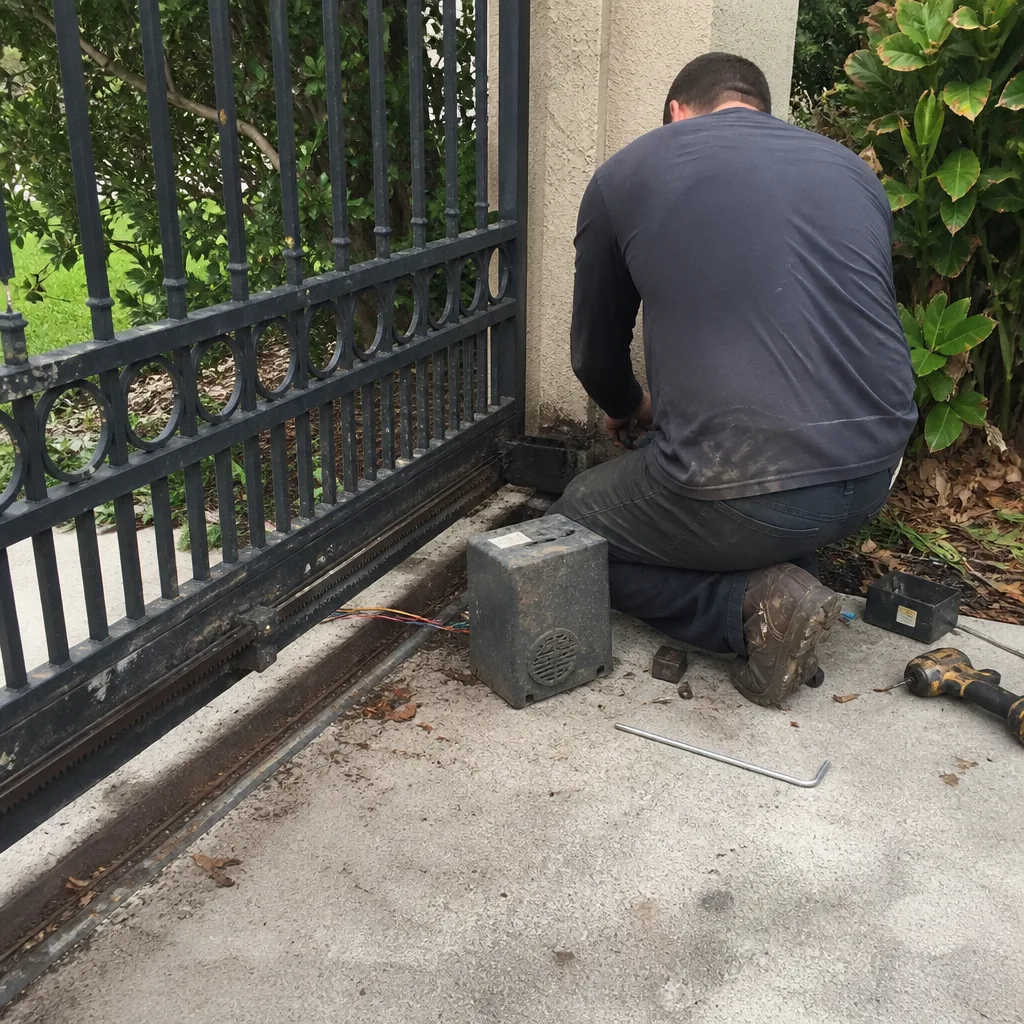 Before
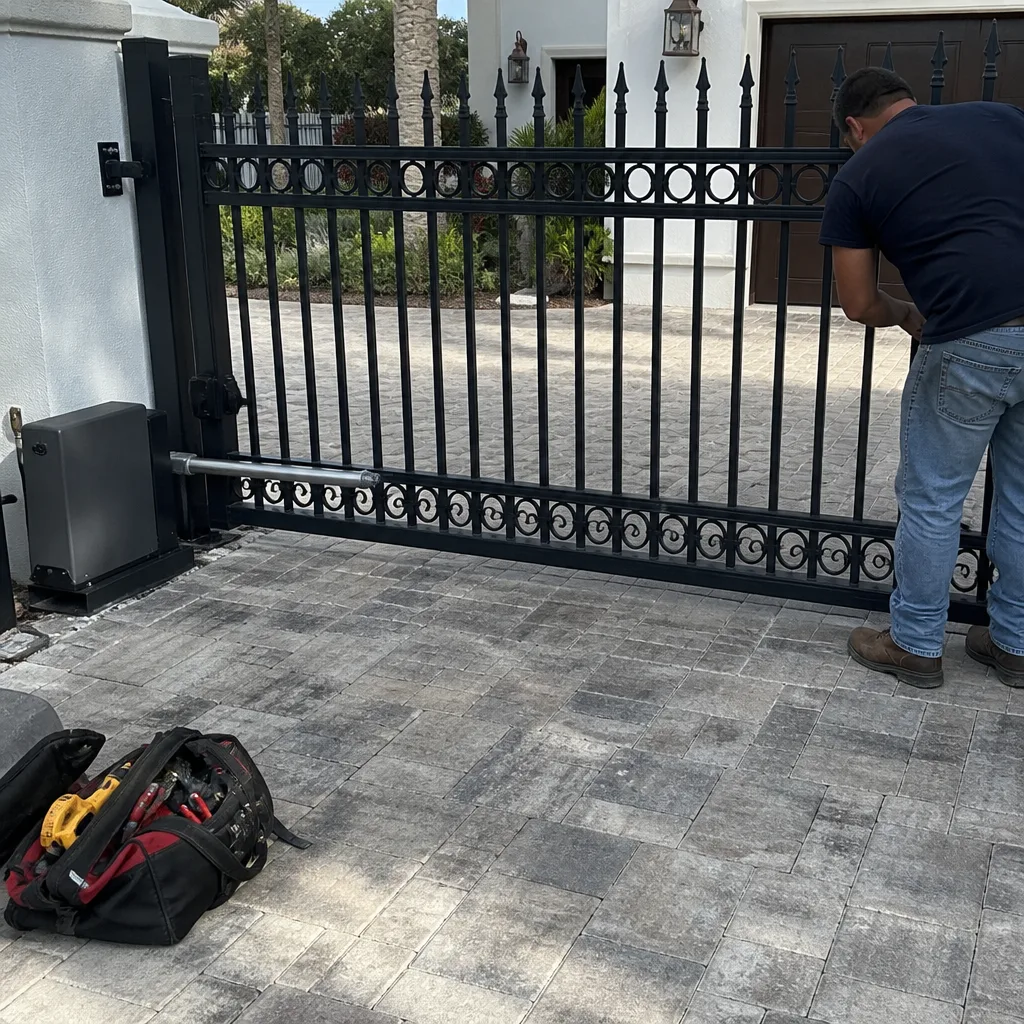 After
After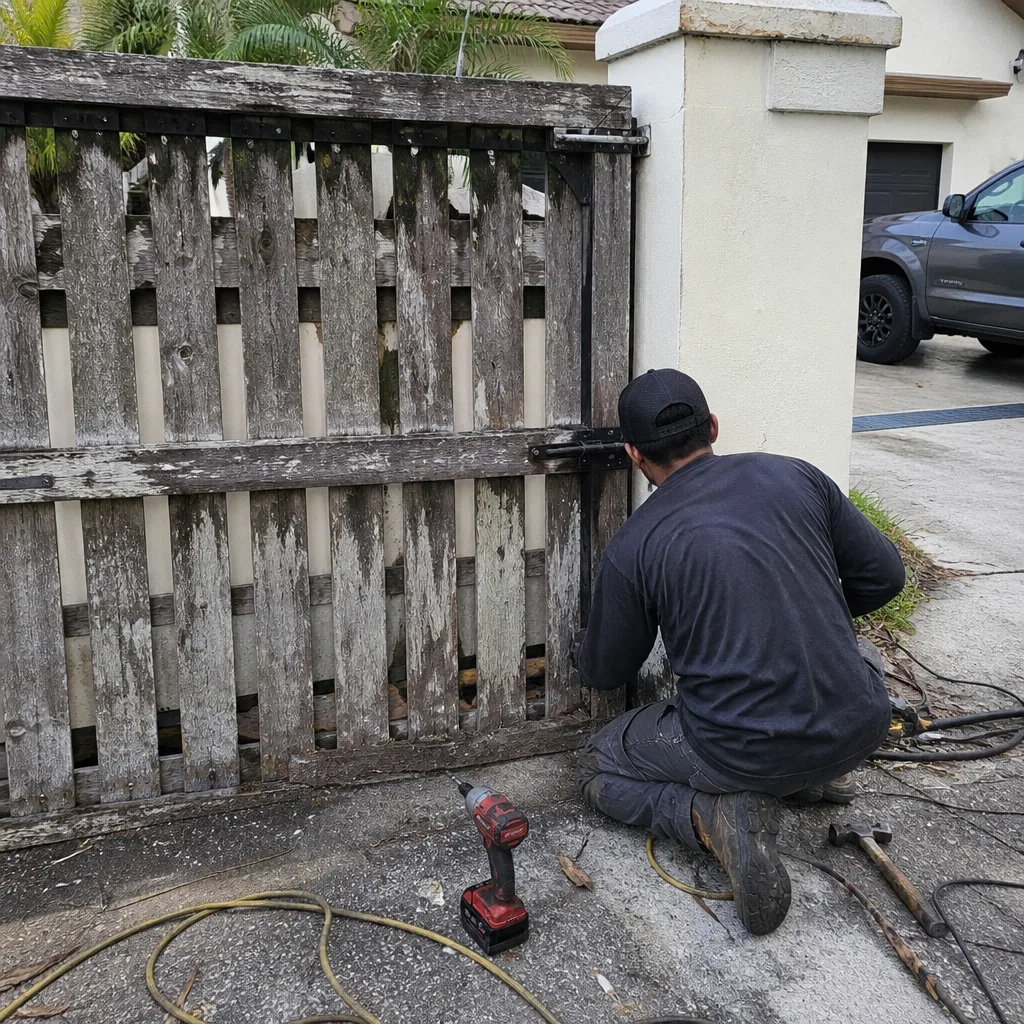 Before
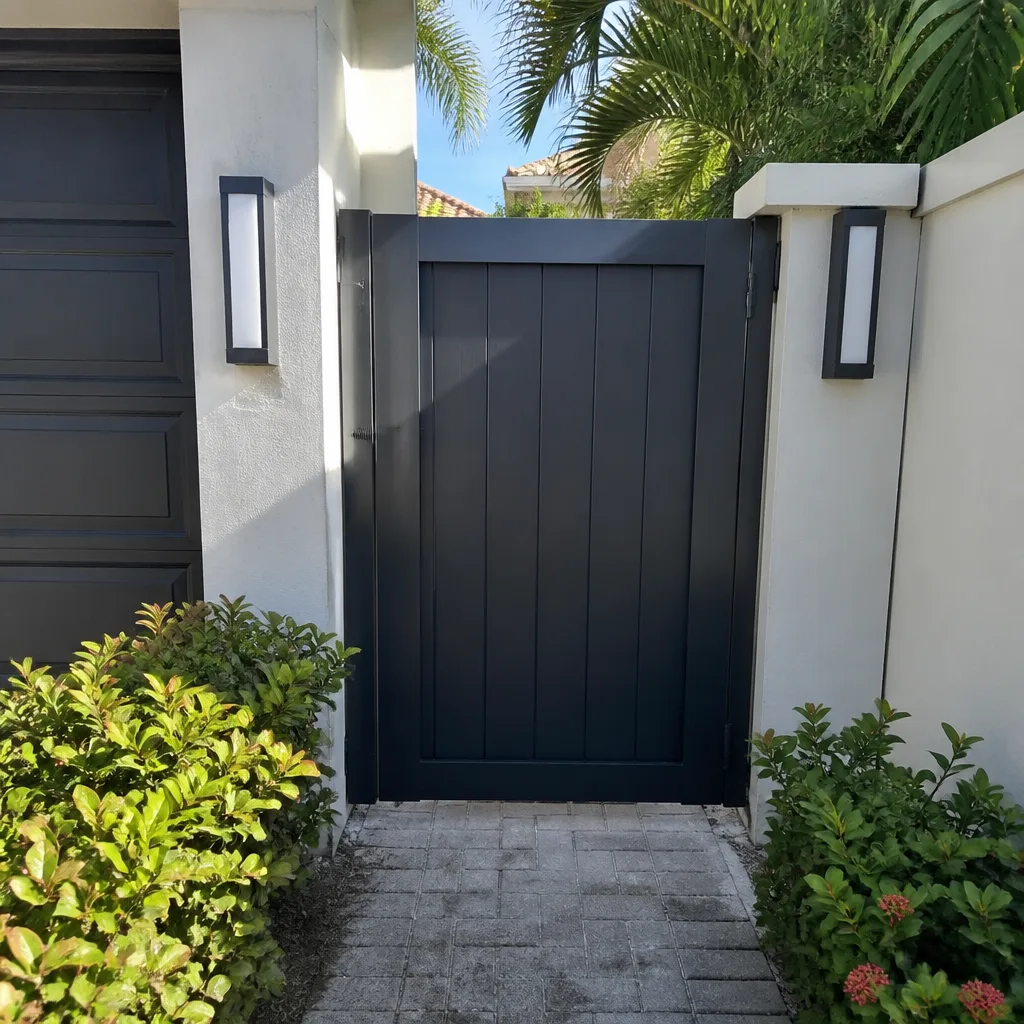 After
After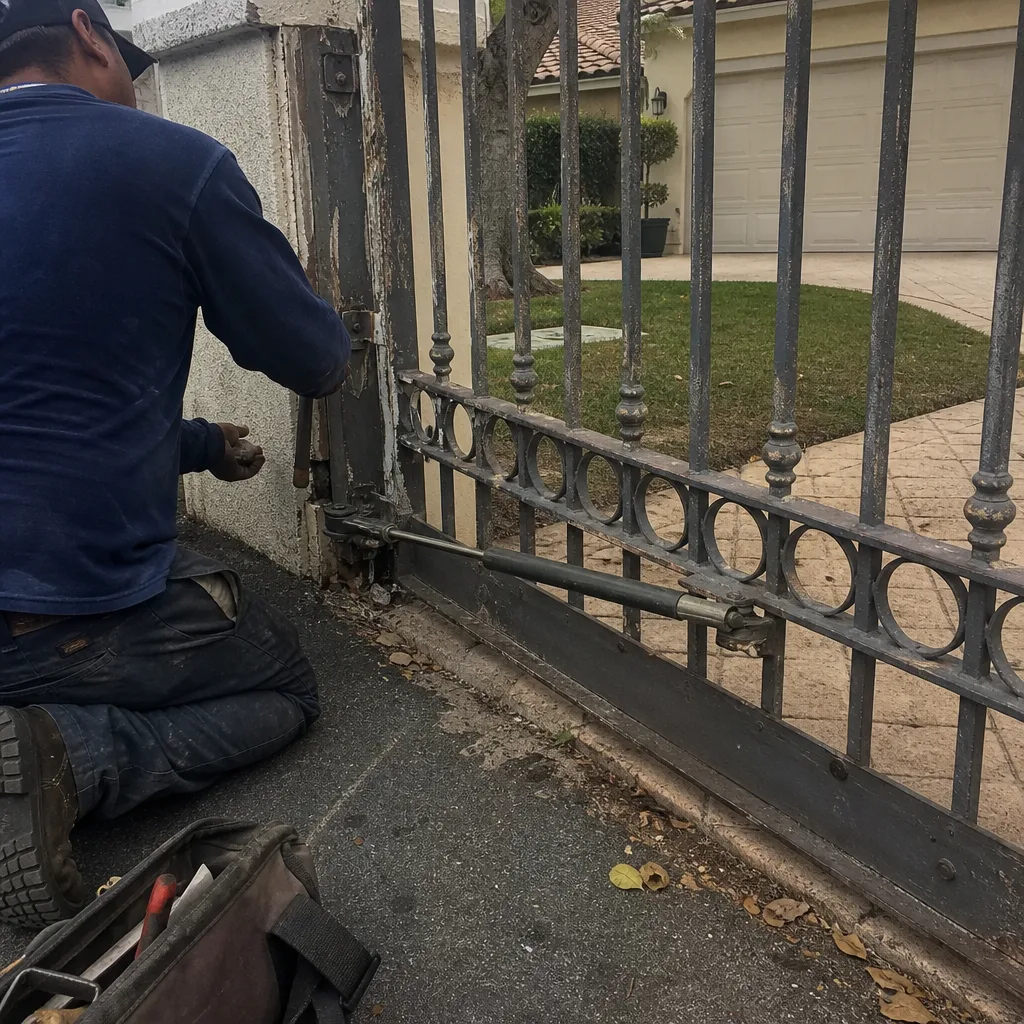 Before
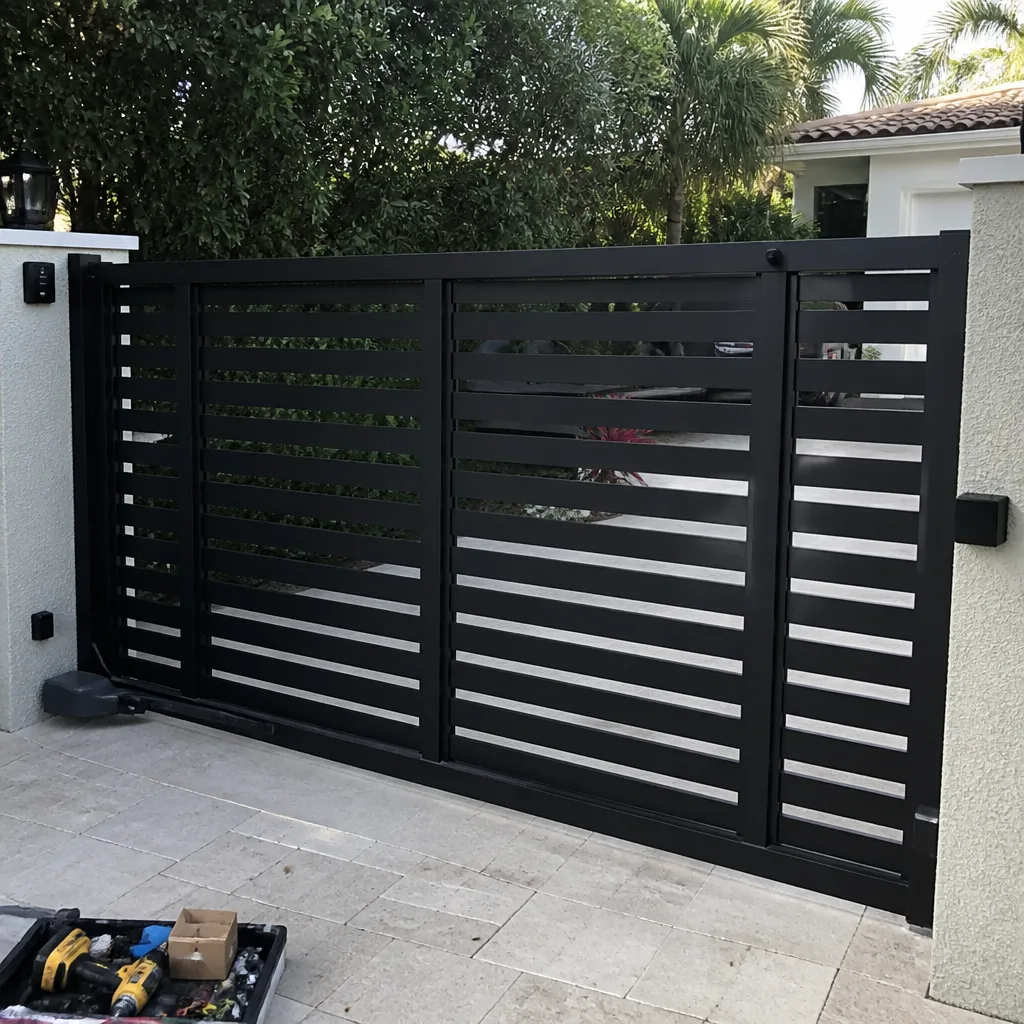 After
AfterGate Repair Maintenance Checklist for Boca Raton Homeowners
Most residential gate maintenance checklists read like they were written for a subdivision in Ohio. They mention lubricating hinges twice a year, checking bolts, and maybe hosing off the track. That advice falls apart in Boca Raton within about four months. Salt air corrodes pivot points faster than inland humidity ever will. Daily afternoon thunderstorms cycle metal through wet-to-dry expansion at a rate that loosens hardware on a schedule no national checklist accounts for. And HOA communities with two or three hundred vehicles passing through a single entrance gate put more wear on an operator in one year than a private driveway gate sees in five. This guide gives you the specific measurements, pass/fail values, and documentation habits we use on service calls across Boca Raton, so you can catch drift before it becomes a repair bill.
Quick Answer
A proper gate maintenance checklist for Boca Raton covers five areas: lubricating pivot points every 4-6 weeks with a marine-grade lubricant, checking amp-draw on the operator motor monthly, photographing the gate from six fixed angles quarterly, measuring limit-switch travel tolerance within 1/8 inch, and logging every reading in a dated maintenance record. In our coastal climate, intervals marked “every 6 months” on generic checklists need to happen every 60-90 days.
Table of Contents
- Lubrication: What Boca Raton Salt Air Does to Gate Hardware
- Reading Amp-Draw: The Number That Tells You the Motor Is Failing
- Limit-Switch Drift: Measuring the Safety Margin
- The Six-Angle Photo Protocol
- Building a 12-Month Maintenance Log a Technician Can Actually Use
- Coastal Checkpoints: Rust, Wire, and Weather Seals
- Common Mistakes to Avoid
- When to Call a Professional
- Frequently Asked Questions
- The Bottom Line
BeforeAfterLubrication: What Boca Raton Salt Air Does to Gate Hardware
A hinge that squeaks in Denver is annoying. A hinge that squeaks in Boca Raton is three weeks away from seizing. The salt content in coastal air accelerates oxidation on unprotected metal surfaces, and that oxidation turns into abrasive grit inside pivot points. That grit is what wears out hinge bushings and operator arms long before the manufacturer’s expected service life.
The fix is not more lubrication. The fix is the right lubrication on the right schedule.
What to Use
Avoid white lithium grease. It’s the most common recommendation in generic gate maintenance guides, and in coastal conditions it congeals, traps salt particles, and becomes a grinding paste within a few months. Instead, use a marine-grade synthetic grease that resists washout from rain and humidity. Look for a product rated for saltwater environments. For hinge pins and operator arm bushings, a heavy-bodied synthetic with anti-corrosion additives works. For the gate track (if you have a sliding gate), use a dry-film lubricant with PTFE rather than any wet grease, because wet lubricants collect sand and shell dust that abrade the rollers.
Boca Raton Intervals
- Swing gate hinge pins: every 4-6 weeks during the wet season (May through October), every 8 weeks in the dry months.
- Sliding gate track and rollers: every 30 days. Sand and salt combine on the track surface and accelerate roller wear when left unlubricated.
- Operator arm bushings and pivot bearings: every 60 days.
- Chain drives (if present): check tension monthly, lubricate every 90 days with a penetrating oil designed for chains, not grease.
If you live east of Dixie Highway, closer to the Intracoastal, shift all intervals down by about two weeks. The salt concentration in the air is measurably higher within a mile of the water. We see it in the corrosion patterns on gate hardware in neighborhoods like Royal Palm Yacht & Country Club and The Sanctuary. Gates further west, in places like Boca West or Mission Bay, still need shorter intervals than inland Florida, but the wear is slower.
What Skipping Lubrication Costs
When a hinge seizes, the operator motor works harder to move the gate. That increased load shows up as higher amp-draw (covered in the next section), and it shortens the motor’s life. A seized hinge pin on a swing gate can also transfer stress to the operator arm bolt, which can shear. The repair for a sheared bolt is $120-$200 for parts and labor. A tube of marine grease costs about $15. The math is that simple.
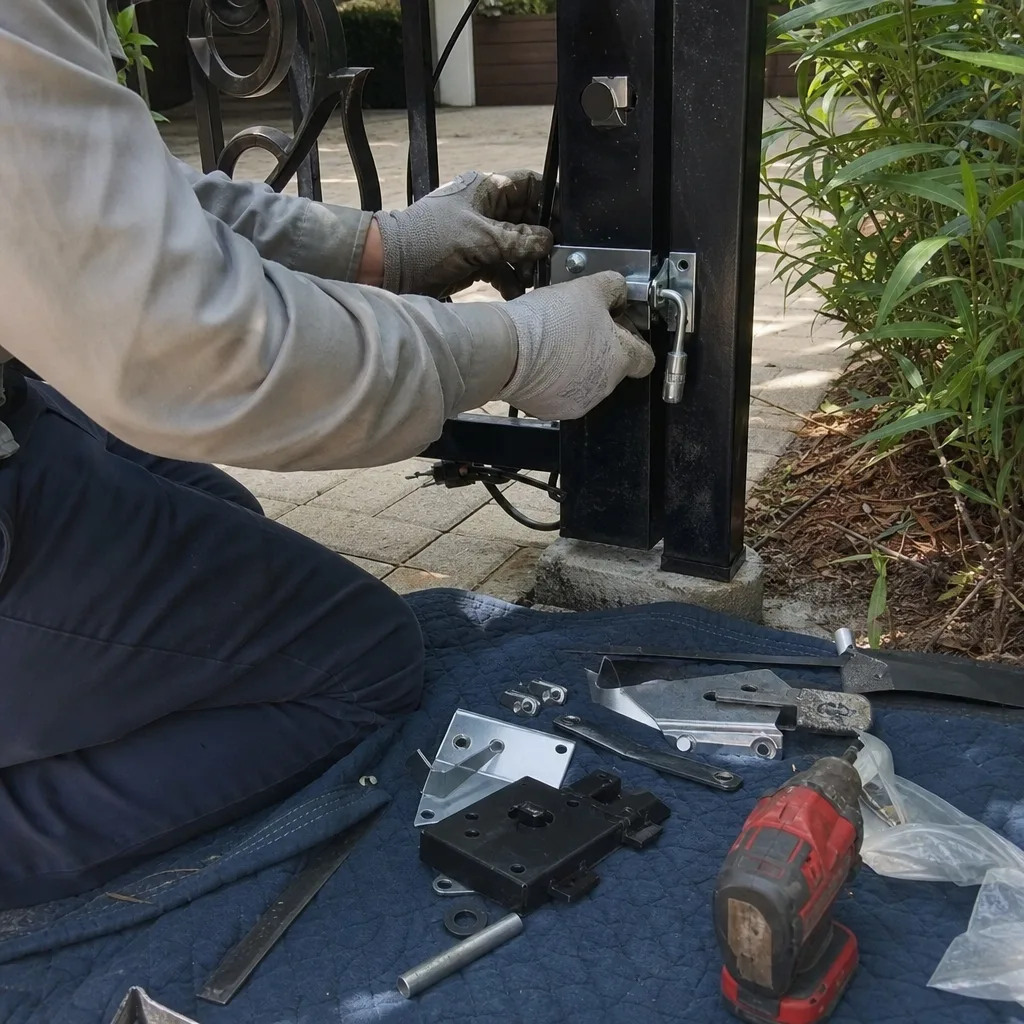
If you’re not sure what your gate’s pivot points look like or what they should feel like when properly lubricated, a gate repair technician in Boca Raton can show you on a maintenance visit and leave you with a written record of what was serviced.
Reading Amp-Draw: The Number That Tells You the Motor Is Failing
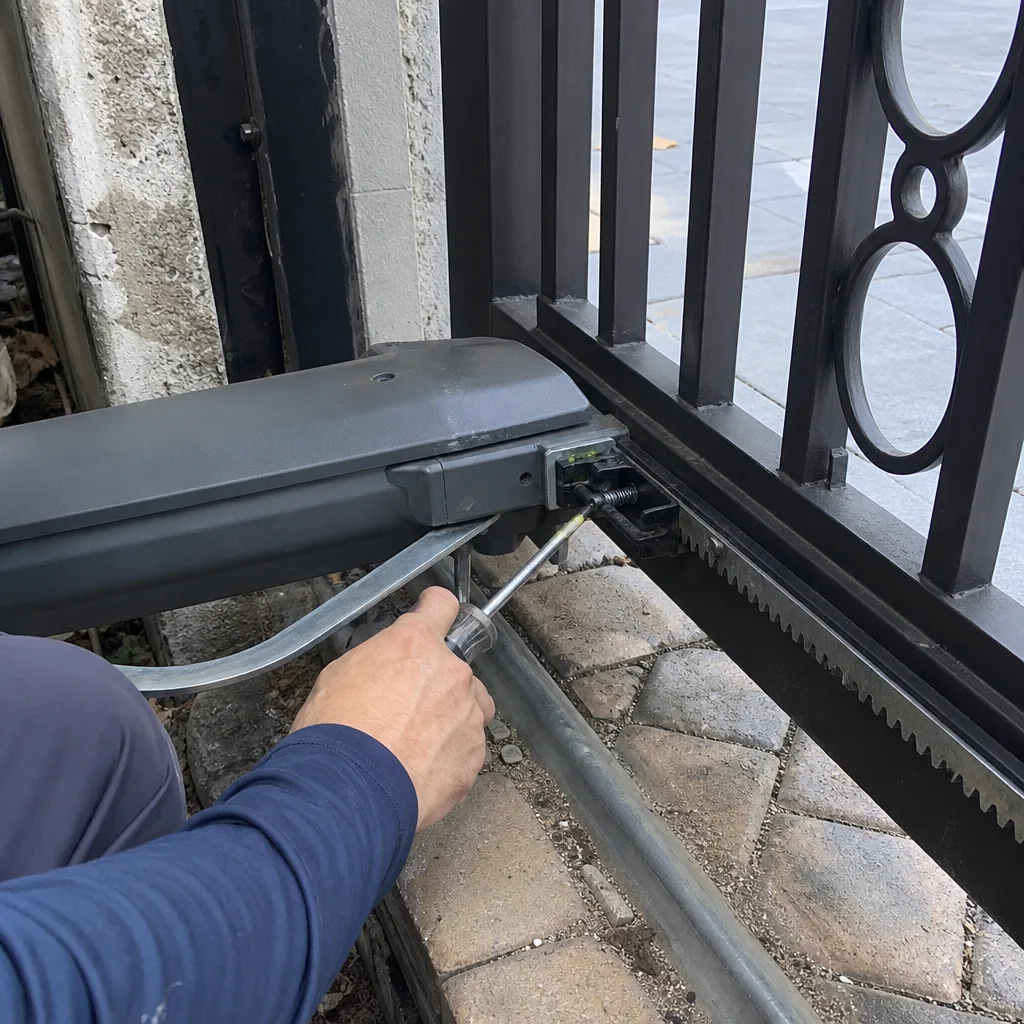
Most homeowners don’t know their gate operator has a diagnostic readout. Many do, and you can access it without taking the cover off in most cases. On LiftMaster, FAAC, and Elite operators, the control board tracks motor current draw, which is the single most reliable early indicator of a motor on its way out or a mechanical problem adding resistance to the gate’s travel.
Here’s how the numbers work.
What to Check
- At rest: With the gate stationary and the operator powered but idle, amp-draw should be near zero, typically 0.1-0.3 amps for the control board itself.
- Under normal load: While the gate is opening or closing at its normal speed, amp-draw should remain within the manufacturer’s listed range. For most residential swing gate motors, that’s 3-6 amps. For sliding gate motors, 4-8 amps is typical.
- Under strain: If the gate hits resistance (wind, a stuck roller, a misaligned track), the motor will draw more current momentarily. A spike that drops back to normal once the resistance clears is expected. A consistent elevation under normal operation is the problem.
The Failure Numbers
- Normal load reading consistently 20-30% above the manufacturer’s spec: Something mechanical is dragging. Look at hinges, rollers, track alignment, or the operator arm.
- Normal load reading consistently 50% or more above spec: The motor is working against serious resistance. It could be a failing bearing, a bent arm, or a motor winding that’s breaking down. This is the point where continued operation risks burning out the motor entirely.
- High amp-draw at rest with no movement: The motor may have a shorted winding. Shut the operator off and call a professional. A shorted winding can damage the control board if left powered.
In our experience across Boca Raton, motors on coastal properties fail faster than inland ones for the same reason hinges do: salt corrosion gets inside the motor housing and degrades the winding insulation. We’ve pulled motors from properties near the Intracoastal where the windings were visibly corroded, and the amp-draw reading had been elevated for months before the motor finally died. The owner had no idea because the gate still opened and closed. But every day it ran hot was another day of insulation degradation.
If you don’t have the owner’s manual for your operator, a gate motor and opener service in Boca Raton can check amp-draw on a maintenance call and record the baseline for future reference.
When to Record It
Check amp-draw monthly. Write down the number every time. The trend is what matters. A motor that draws 4.2 amps in January and 4.4 amps in February is normal. A motor that draws 4.2 in January, 4.8 in February, and 5.6 in March is telling you something is degrading. You want to catch that trend in month two or three, not month seven when the motor is smoking.
Limit-Switch Drift: Measuring the Safety Margin
Limit switches tell your gate operator where the gate begins and ends its travel. On most residential operators, the limit is set electronically on the control board or physically with a magnetic switch on the arm. When the limit drifts, the gate stops short of fully open, overtravels past fully closed, or reverses unexpectedly.
Drift happens gradually. It’s not a sudden failure. It’s a slow accumulation of motor revolutions, temperature cycles, and mechanical slack. In Boca Raton, the expansion and contraction from daily heat and afternoon rain accelerates this drift compared to drier, more temperature-stable climates.
What Drift Looks Like
- Stopping short: The gate stops 2-3 inches before it reaches the open position. Not a problem for pedestrians, but a consistent annoyance for anyone pulling a car through.
- Overtravel at close: The gate presses hard against the close stop, or the motor strains audibly for a second before shutting off. This is the dangerous one. Overtravel at close is what leads to bent arms, cracked weld joints, and eventually gate failure at the worst possible time.
- Reversal after stop: The gate reaches the close position, then bounces back slightly and sits off-center. This indicates the limit switch is setting beyond the mechanical stop, or the stop itself has shifted.
How to Measure It
- Start with the gate fully closed. Place a piece of painter’s tape on the ground exactly where the gate’s leading edge rests.
- Run the gate through a full open and close cycle.
- When it returns to close, check where the leading edge rests relative to the tape. A gap or overlap of more than 1/8 inch means the limit has drifted.
- Repeat the measurement on the open side.
One-eighth of an inch is the tolerance. Less than that is normal mechanical variation. More than that, and you should correct the limit setting or have it corrected. The correction itself is straightforward on most LiftMaster and FAAC residential operators: it involves accessing the limit-adjustment procedure on the control board and resetting the open and close positions. The manual has the exact button sequence. If the drift returns within a few weeks, the limit switch itself may be failing, which requires replacement rather than adjustment.
An operator that consistently overtravels at close will eventually damage the gate structure at the weld points. We’ve repaired gates in Boca Raton neighborhoods like Woodfield Hunt Club where the weld at the hinge post had cracked through completely because the limit switch had been overtraveling for months. The owner thought the gate was just “noisy.” The repair required cutting out the cracked section, re-welding, and repainting. Had the limit been corrected when the drift first appeared, it would have been a 20-minute adjustment instead of a structural repair.
The Six-Angle Photo Protocol
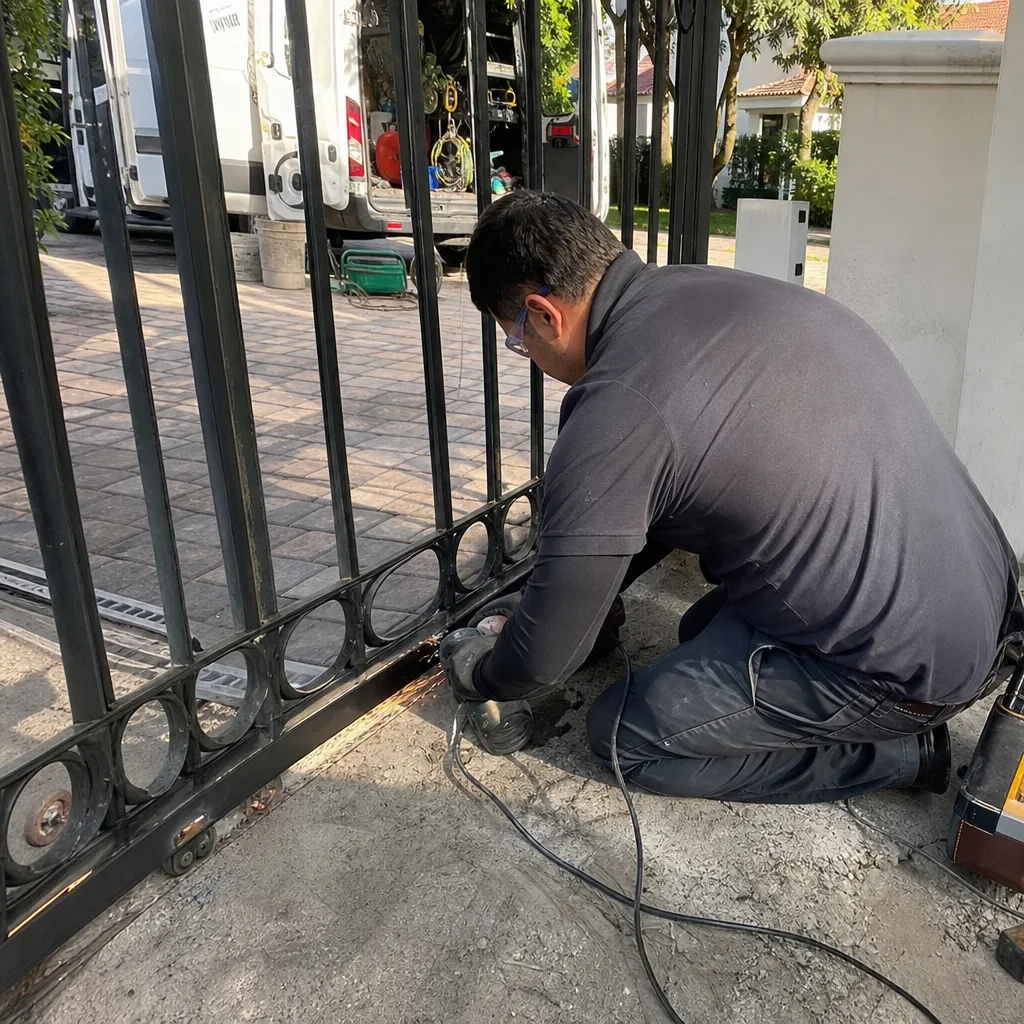
This is the section most maintenance checklists skip entirely, and it’s the one we tell every Boca Raton homeowner to adopt. Photographs are the only way to see gradual change. Your eye adjusts to small differences over time. A photo from six months ago makes the rust, the sag, the track wear immediately obvious by comparison.
Here’s the protocol. Take these six shots every quarter. Store them in a folder on your phone or computer with the date in the filename. That’s it.
- Full gate from the street, closed: Shows overall alignment, sagging, rust spots, and paint condition. Stand back far enough to capture the entire gate and both posts.
- Full gate from the property side, closed: Captures the hinges, operator arm, and any hardware mounted on the interior face.
- Close-up of the lower hinge (both leaves): Shows wear on the hinge pin, bushing play, and rust accumulation. On a sliding gate, substitute the lower track roller.
- Close-up of the operator arm and mounting bracket: Shows bolt tightness, arm angle, and any bending or stress marks. Shoot this from the side, not head-on.
- Close-up of the gate’s leading edge (where it meets the stop): Shows the gap or contact point. When limit-switch drift happens, this photo series documents the movement over time.
- Wide shot of the track (sliding gates only): Shows debris accumulation, track wear, and roller condition. Shoot from the end of the track looking down its length.
This is the same documentation habit we use on every service call at Vance Gate Repair Boca Raton. Every visit leaves a photo log of what was found, what was adjusted, and what was installed. The homeowner gets the record, and we file it in the job history. When something changes six months later, we’re not guessing what the gate looked like when we left it. We have the photographs. You can run the same system on your own gate, and it costs nothing.
Building a 12-Month Maintenance Log a Technician Can Actually Use
The purpose of a maintenance log is not to prove you did maintenance. The purpose is to give a future technician context. If you sell the house, the new owner inherits the gate and whatever documentation you left. If you hire a different gate company, the technician can read your log and know exactly what’s been done, what’s been replaced, and what was normal the last time you checked.
Most homeowner maintenance logs fail because they’re either too vague (“Gate seems fine”) or too scattered (receipts in a drawer, notes on three different phones). Here’s a structure that works.
The Log Format
- Date of every check, lubrication, adjustment, or repair.
- What was done: specific, factual. “Lubricated hinge pins with marine grease. Hinge 1 (bottom) was dry and squeaking. Hinge 2 was still coated.” Not “serviced hinges.”
- Readings: amp-draw at rest and under load, limit-stop measurement from tape test, any unusual noise or resistance noted.
- Parts installed (if any): brand, part number, source. Write it down even if the technician provides it. Future technicians can chase a part number faster than a description.
- Photos taken: note that you ran the six-angle protocol and where the files are stored.
One Year of Entries
If you’re starting fresh, here’s what a complete 12-month log looks like in practice, not theory:
- Month 1: Six-angle photo protocol. Amp-draw baseline recorded. Limit-stop test (should read within 1/8 inch). Lubricate hinge pins.
- Month 2: Lubricate hinge pins. Quick visual check of operator arm and bolts. No amp-draw needed.
- Month 3: Six-angle photo protocol. Amp-draw check. Limit-stop test. Lubricate hinge pins.
- Month 4: Lubricate hinge pins. Inspect gate track for debris (sliding gates).
- Month 5: Amp-draw check. Limit-stop test. Lubricate hinge pins.
- Month 6: Six-angle photo protocol. Full visual inspection. Lubricate hinge pins. Check all mounting bolts for tightness. This is the point where most generic checklists call for their first maintenance, and in Boca Raton it’s already behind schedule.
- Months 7-11: Repeat the monthly lubrication. Quarterly photo protocol at months 9 and 12. Amp-draw and limit test monthly.
- Month 12: Full annual review. Compare current photos to the ones from month 1. Note any rust progression, sag, or alignment change. If replacing anything, write the part number in the log.
A technician who picks up this log knows more about your gate in two minutes than most homeowners can tell them in a phone call. It eliminates the diagnostic guesswork. At our gate installation work in Boca Raton, we hand every new gate owner a maintenance sheet with exactly this structure, and we recommend they keep it in a plastic sleeve inside the operator housing or on the wall of the garage nearest the gate.
Coastal Checkpoints: Rust, Wire, and Weather Seals
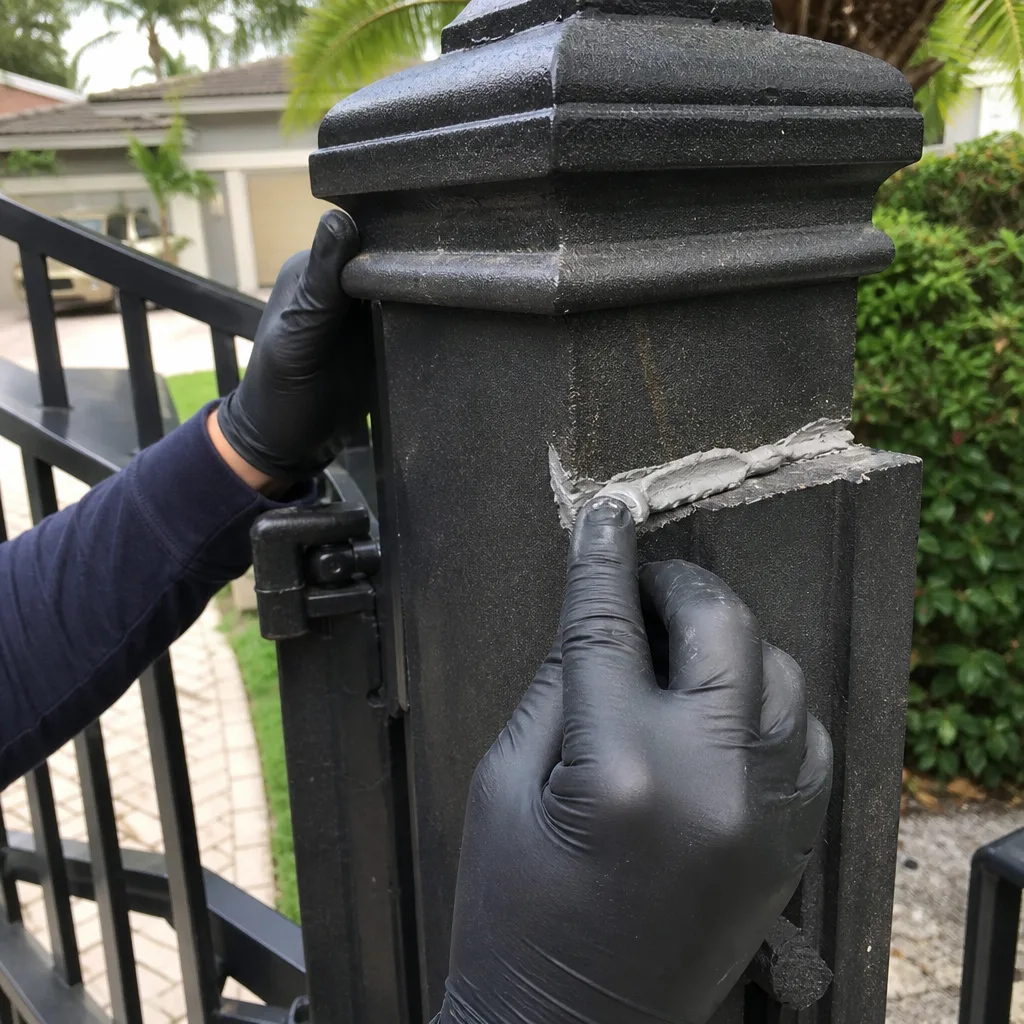
Beyond lubrication and limit switches, Boca Raton’s coastal environment attacks a gate in three ways that inland checklists ignore entirely: rust on structural welds, corrosion inside the operator’s electrical connections, and wear on weather seals and covers that let the first two problems in.
Rust on Structural Welds
Weld joints are the most vulnerable points on a steel gate. The welding process burns off the protective coating at the joint, and if the gate wasn’t re-coated properly after fabrication, those joints begin rusting within the first or second season. In Boca Raton, that timeline is shorter. Check every weld on the gate frame quarterly. Look for any bubbling under the paint, which means rust is forming underneath. Surface rust can be wire-brushed and touched up with paint. Rust that has penetrated into the joint itself, visible as flaking or pitting at the weld, needs attention from a welder before the joint weakens.
Electrical Corrosion
The terminal strips and wire connections inside your operator housing are not sealed against humidity. In a coastal climate, the connections oxidize, resistance climbs, and heat builds. That’s a fire risk and a failure point. Once a year, or any time you have the operator cover off, look at the terminal connections. Green or white corrosion on copper wires means moisture is getting into the housing. Loose or discolored terminals should be tightened or replaced. We’ve pulled the cover off operators in Boca Raton and found terminal strips so corroded the wire crumbled when touched. The gate still ran, but only just.
Weather Seals and Covers
The gasket around the operator cover degrades in direct sun and salt air. Once the gasket fails, the housing is no longer sealed, and the internal components are exposed to humidity. Check the gasket every six months. Look for cracking, flattening, or gaps. On Mighty Mule operators, the plastic housing itself can warp in prolonged sun exposure, which breaks the seal even if the gasket is intact. Replace the gasket or the housing cover when it no longer fits snugly. It’s a $50-$80 part that protects a $400-$800 control board.
If you’re inspecting a gate mounted on a home you’ve just purchased, and you don’t have any maintenance history, a gate installation specialist in Boca Raton can perform a full audit and give you a written list of what’s salvageable, what’s borderline, and what needs attention immediately.
Common Mistakes to Avoid
- Using white lithium grease on coastal gate hardware. It attracts salt and grime and turns to paste. Marine-grade synthetic grease is what the environment requires. If you’ve been using white lithium, clean the hinge pins thoroughly before switching products.
- Ignoring a noisy gate because it still works. A gate that squeaks, groans, or bangs is telling you something mechanical is failing. The longer you run it, the more components wear. Noise is the earliest and cheapest diagnostic signal you’ll ever get.
- Adjusting the limit switch to compensate for a sagging gate. If the gate sags because a hinge is worn, changing the limit setting masks the problem while the hinge continues to deteriorate. Fix the mechanical issue first, then reset the limits.
- Lubricating the photo-eye lenses with anything at all. Photo-eyes (the infrared beam that stops the gate if something crosses the path) need cleaning, not lubrication. Wipe the lenses with a dry microfiber cloth. Any lubricant on the lens diffuses the beam and causes false fault activations or, worse, prevents the safety reverse from triggering.
- Skipping the photo documentation because the gate “looks fine.” Fine is relative, and your eyes adjust. The photos are the only objective record. Four quarterly photo sets take ten minutes total per year and give you a visual timeline that money can’t recreate retroactively.
- Running the gate on generator power during an outage without checking the output. Boca Raton’s storm season means generator use on some properties. Many residential generators produce dirty power (voltage spikes, frequency drift) that gate operator control boards do not tolerate. If your electrical setup puts the gate operator on a generator circuit, have the output tested against the operator’s voltage tolerance. Dirty power can cook a control board in one storm season.
- Not recording part numbers. Every time something gets replaced, write down the make and part number. When the part fails again, or when a different technician works on the gate, a part number saves an hour of research and eliminates the risk of ordering the wrong component.
When to Call a Professional
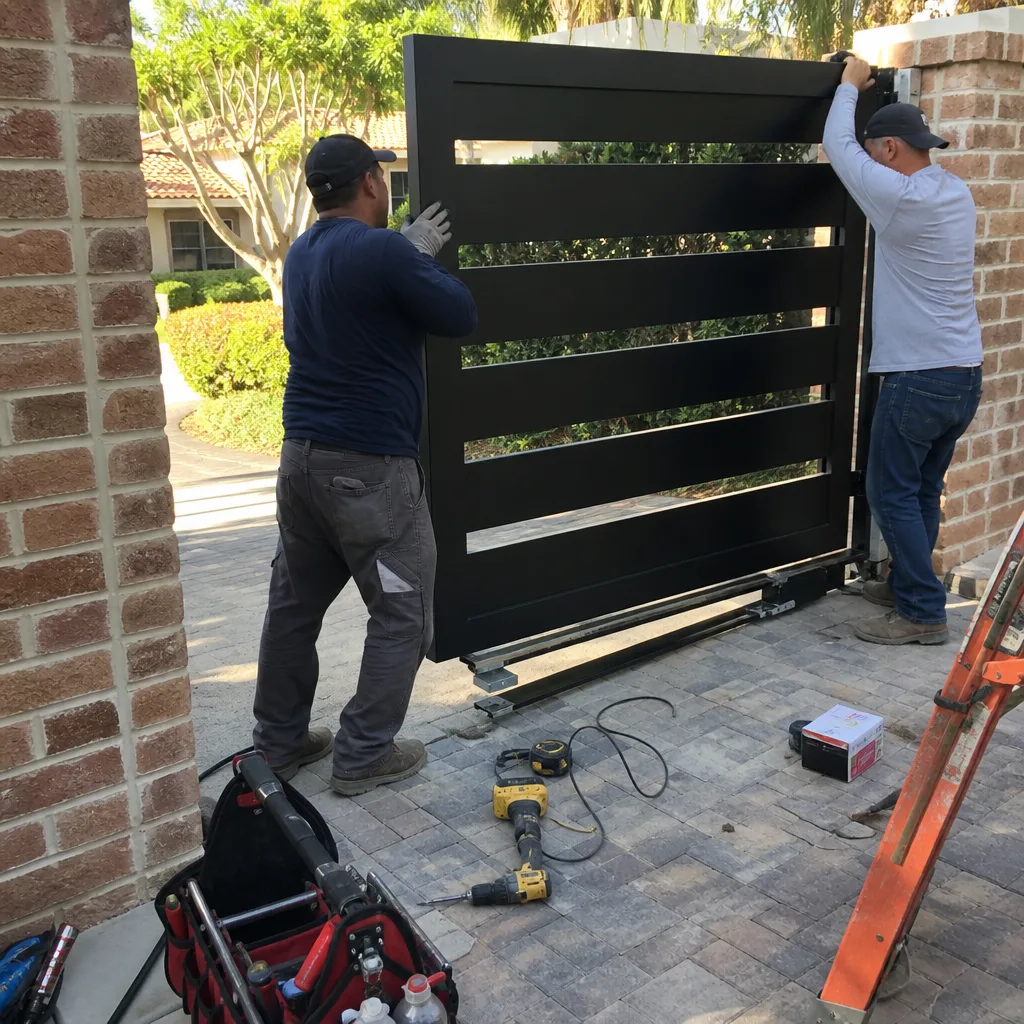
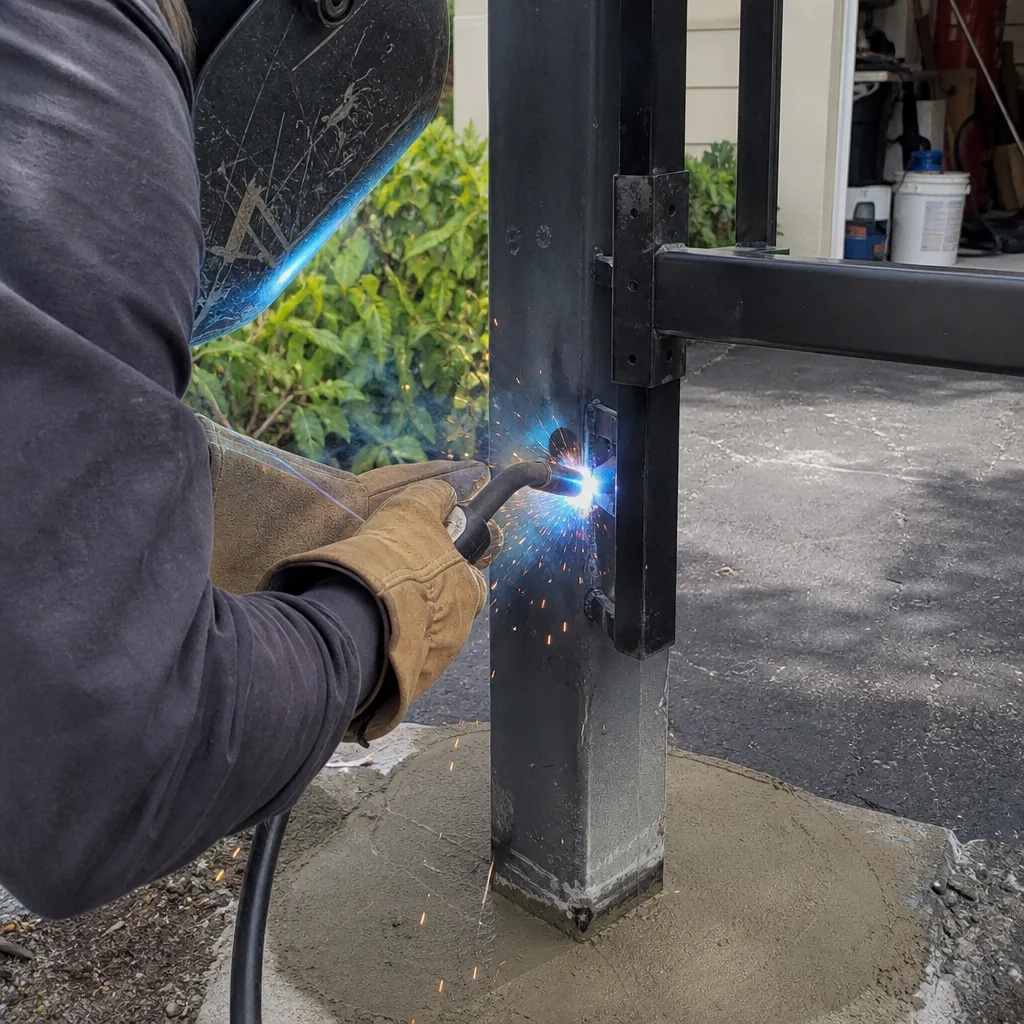
Keep in mind that gate operator internals carry live line voltage, and the gate itself is a heavy moving object. Amperage readings and limit-switch adjustments happen inside the operator housing. If you’re not confident working around exposed electrical terminals, call someone who is. Same with welding repairs and any structural work: a weld that fails while the gate is in motion turns a few hundred pounds of steel into a hazard. This is not DIY territory.
You should call a professional if you see consistent amp-draw readings above manufacturer spec, if your limit switch drifts repeatedly after correction, if any weld shows penetrating rust, if the operator housing has visible water intrusion or electrical corrosion, or if the gate has ever reversed onto anything or anyone. Vance Gate Repair Boca Raton offers free estimates in Boca Raton, and the written price you get before any work starts is the price you pay. Call (754) 666-7602 and a live person answers, day or night.
Frequently Asked Questions
Hinge pins need marine-grade grease every 4-6 weeks during the wet season (May-October) and every 8 weeks in the dry months. Sliding gate tracks need lubricating every 30 days, and operator arm bushings every 60 days. Properties within a mile of the Intracoastal should shorten these intervals by about two weeks due to salt air concentration. Call (754) 666-7602 for a maintenance check if you’re unsure what your specific gate needs.
Most residential gate maintenance visits in Boca Raton run between $85 and $175, depending on the gate type, operator brand, and whether any adjustments or minor parts are needed. The price for any corrective work is quoted separately and agreed before it’s done. For an exact quote on your gate, call (754) 666-7602 and describe what you have. Estimates are free.
The earliest sign is a consistent amp-draw reading 20-30% above the manufacturer’s spec while the gate operates normally. This indicates a mechanical problem or a motor beginning to fail. Other signs include sluggish movement, a hot motor housing after operation, or a burning smell near the operator. If you see any of these, call a professional before the motor fails entirely.
The most common repair we see in Boca Raton is a failed or drifted limit switch, often caused by salt air corrosion or moisture inside the operator housing. The second most common is a worn hinge or roller assembly from the combination of salt and sand. Both are caught early with the maintenance schedule in this guide. For a complete list of the gate repair services available in Boca Raton, see our service page.
Lubrication, photo documentation, and visual inspections are all safely within homeowner capability with the guidance in this checklist. Amp-draw readings and limit-switch adjustments involve opening the operator housing, which exposes live electrical terminals. If you’re not comfortable working around electricity or with moving weight, leave those items to a technician. The high-tension parts of a gate, particularly torsion springs on some systems, should never be serviced by anyone without proper training and tools.
With proper maintenance, a residential gate operator in Boca Raton lasts 8-12 years. Without the coastal-specific maintenance in this guide, that range drops to 5-7 years in many cases. The salt air and humidity are the determining factors. An operator that lasts 15 years inland can fail in 8 years near the Intracoastal if the housing seal is compromised and corrosion gets inside. Brands like LiftMaster and FAAC are reliable when maintained, and the motor replacement is often avoidable if the corrosion is caught in the first two or three years.
The Bottom Line
A gate maintenance checklist that only says “lubricate the hinges” is decoration. The version that works in Boca Raton is specific: marine-grade grease on a 4-6 week schedule, monthly amp-draw readings with the trend recorded, limit-switch drift measured against a 1/8-inch tolerance, and a six-angle photo log every quarter. The numbers tell you when something is wrong before it breaks. The photos give you a record no memory can match. And a dated log, written in plain language with part numbers, means any technician who ever touches your gate works with context instead of from scratch. That’s the maintenance habit that saves real money in coastal Florida.
If you run through this checklist and find readings outside the ranges here, or if you just want a professional baseline to start from, call Vance Gate Repair Boca Raton at (754) 666-7602. We’ll give you a written price before any work starts, and we’ll leave you with the photo record and documentation to make the next maintenance cycle easier.
Written by Adrian Vance, Owner at Vance Gate Repair Boca Raton, serving Boca Raton since 2014.