
Last updated September 20, 2026
Free on-site gate assessment - hinges, posts, and your LiftMaster or Nice gate operator checked before anything is quoted
The assessment is free and the quote is the invoice.

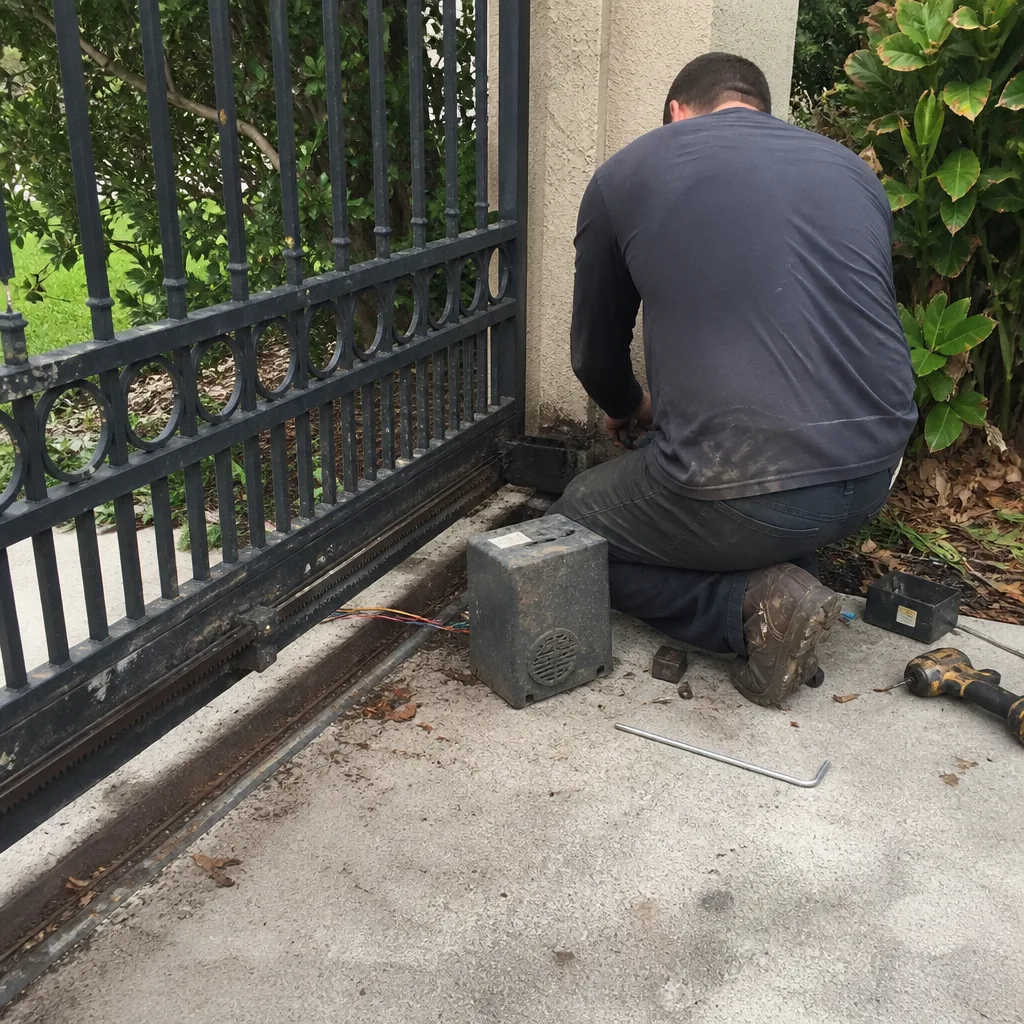 Before
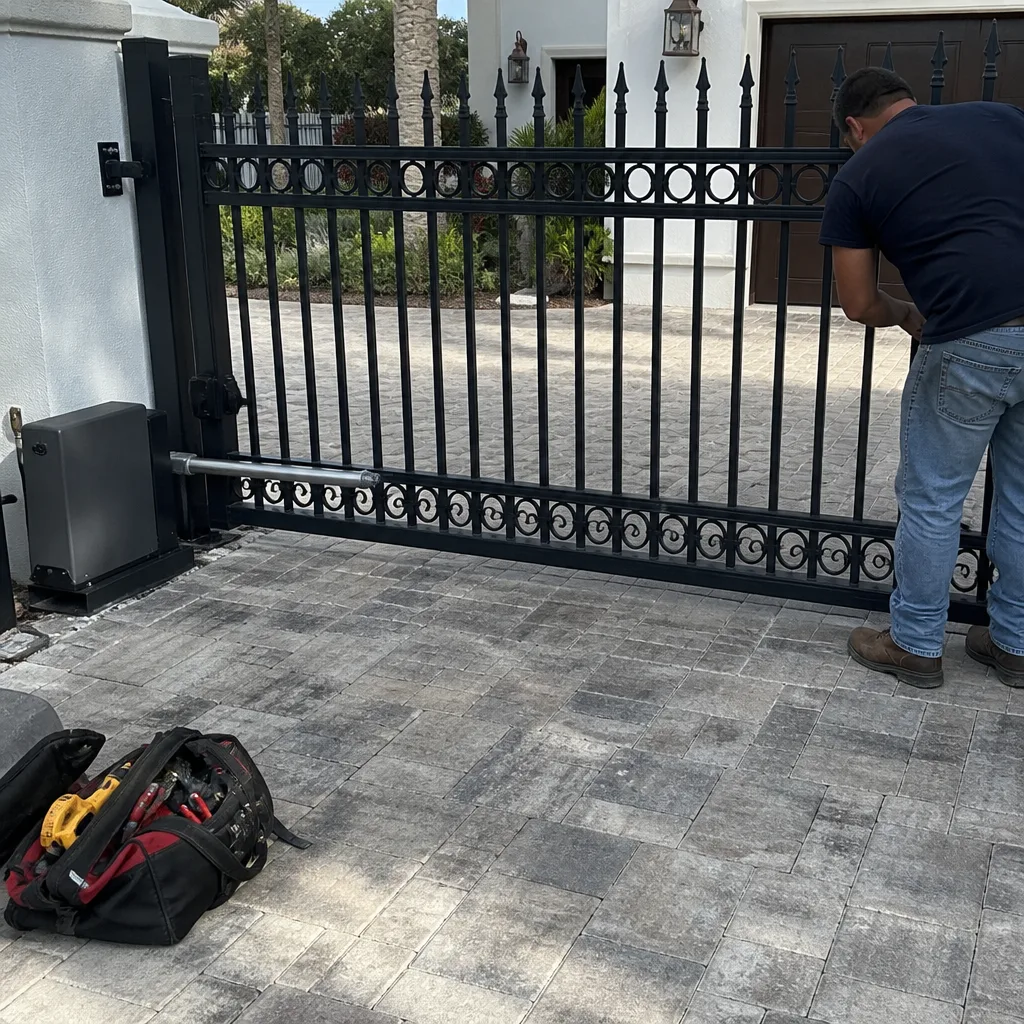 After
After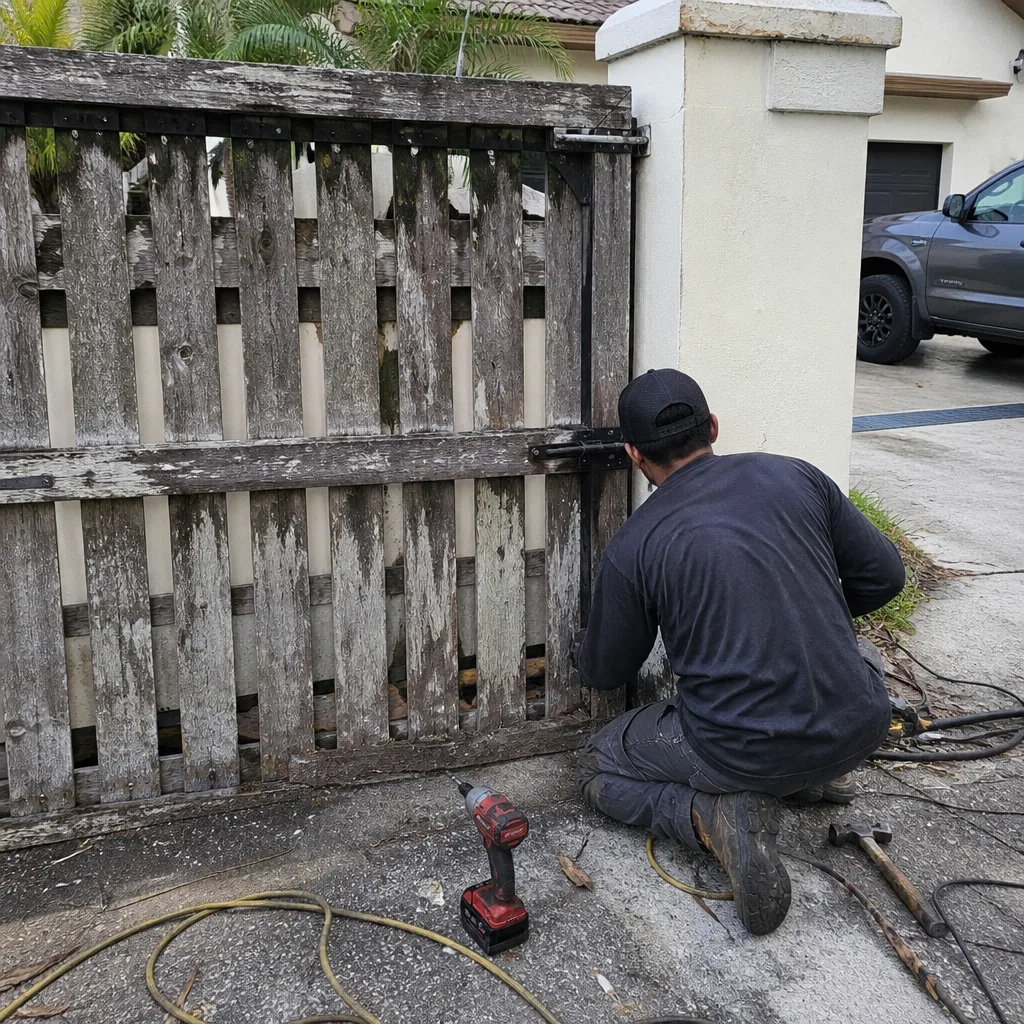 Before
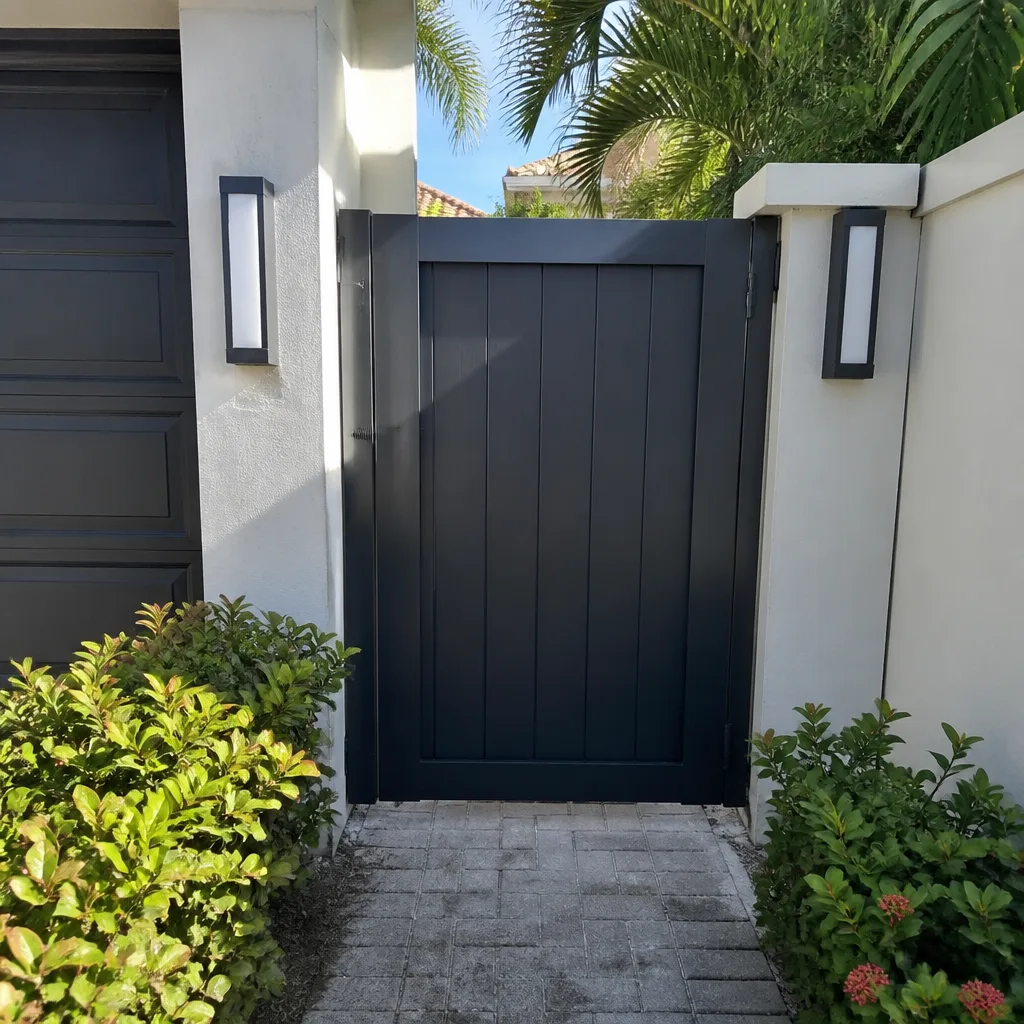 After
After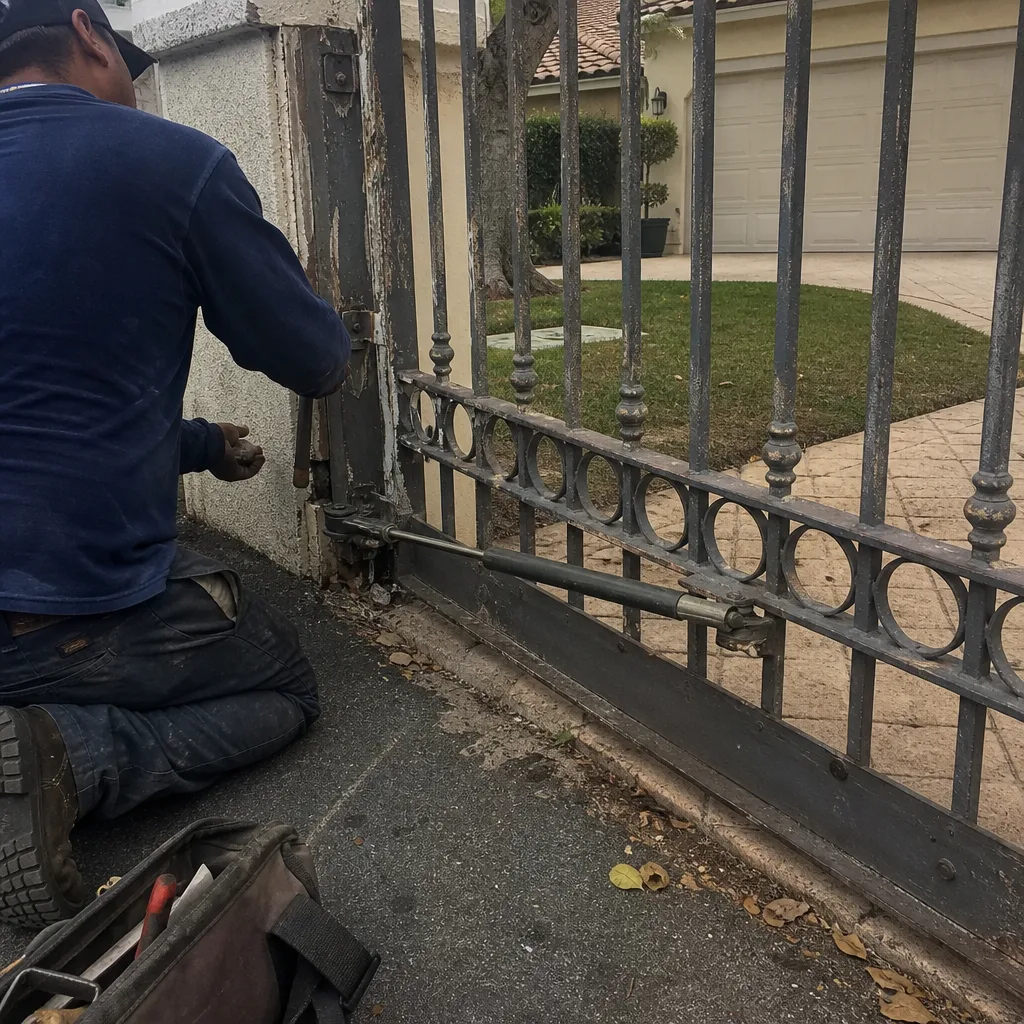 Before
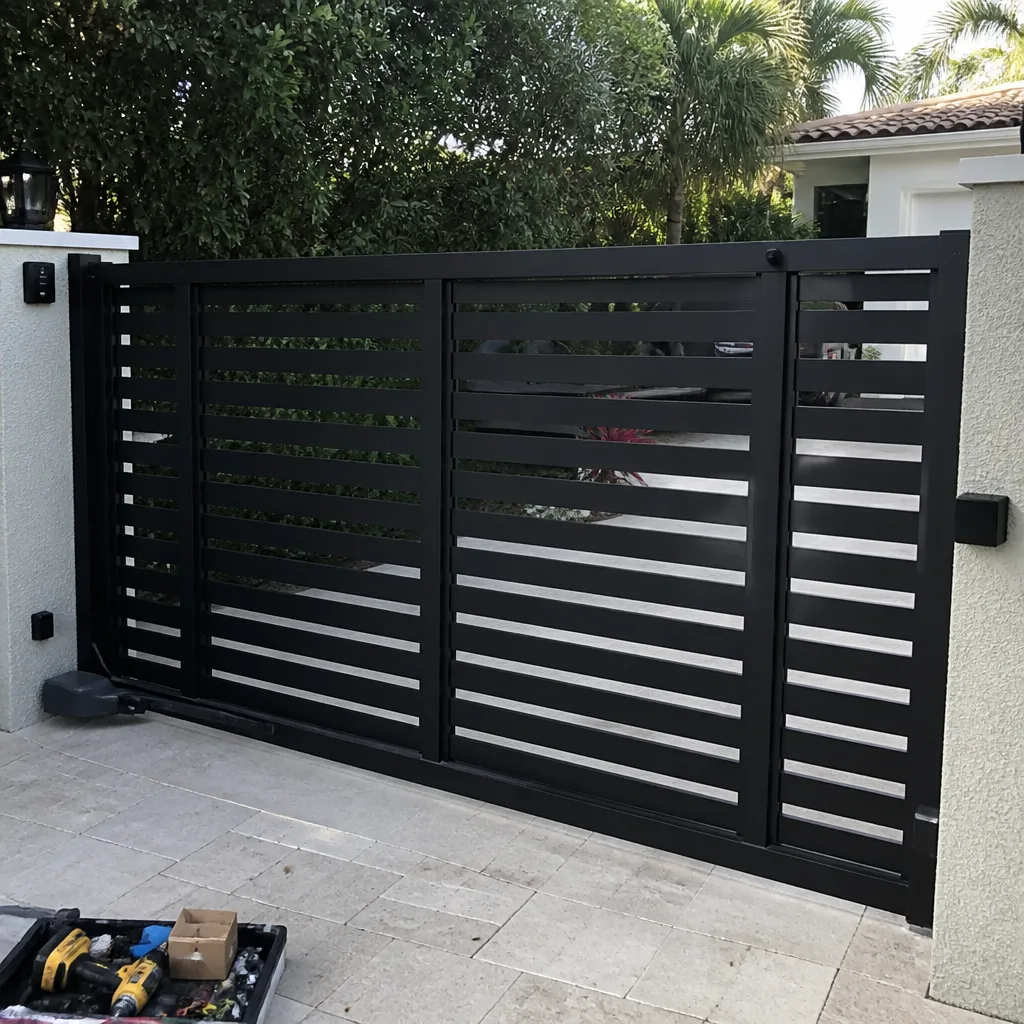 After
AfterDIY vs Professional Gate Repair: The Boca Raton Homeowner’s Decision Guide
Gate repair is the only major home system where a perfectly executed DIY fix can still leave you legally exposed. A gate that closes on a child, a delivery driver, or a neighbor’s car doesn’t care whether the limit switch was adjusted by a homeowner or a technician. It cares whether the UL-325 entrapment protection was set correctly, and so does the attorney who files the claim. This guide-along with more guides & resources on our blog-gives Boca Raton homeowners what YouTube doesn’t: a clear map of which repairs are safe to self-perform, which ones create liability the moment you touch them, and how to document the work you do yourself so it doesn’t cost you twice.
Quick Answer
Boca Raton homeowners can safely DIY roughly 70% of routine gate maintenance, including battery replacement, track cleaning, hinge lubrication, and photo-eye lens wiping. The other 30% involves limit switches, force settings, capacitor replacement, and any wiring tied to entrapment protection sensors. Those require calibration tools and a documented record showing the gate meets UL-325 compliance, because when a self-repaired gate injures someone, Florida liability law treats the person who adjusted it last as the responsible party.
Table of Contents
- The Florida Liability Line: What You Own When You Touch a Gate
- The Task Matrix: Safe to DIY, Needs a Pro, and Never Touch
- Three Repairs That Look Simple and Cost Thousands When Done Wrong
- The Documentation Gap: Why an Undocumented DIY Fix Costs More Than the Repair
- Warranty Voids and UL-325 Compliance: What Self-Performing Actually Cancels
- How to Document a DIY Gate Repair That a Future Technician Can Actually Build On
- Boca Raton-Specific Factors: Salt Air, HOA Rules, and Hurricane Season
- What DIY Actually Saves (and What It Costs in Tooling and Time)
BeforeAfterThe Florida Liability Line: What You Own When You Touch a Gate
Florida law doesn’t distinguish between a gate you fixed yourself and one a technician adjusted. When a gate closes on someone, the question isn’t who installed it in 2016. The question is who adjusted it last.
That distinction matters in Boca Raton, where gated communities are dense, shared-access gates are common, and the gate you adjust on your own driveway may belong to an HOA that carries its own liability policy. If you adjust a limit switch and the gate later reverses into a vehicle or fails to reverse on a person, the liability claim doesn’t start with the gate manufacturer. It starts with the most recent modification, and if that modification is yours, your homeowner’s policy is the first in line.
What homeowner’s insurance typically covers after a self-repaired gate causes injury:
- Medical payments coverage for guests injured on your property, subject to your policy’s limits and exclusions.
- Property damage to a neighbor’s vehicle or fence if the gate strikes it, minus your deductible.
- Legal defense costs if you’re named in a lawsuit, up to policy limits.
What homeowner’s insurance typically doesn’t cover:
- Intentional or grossly negligent modifications. Removing a safety photo-eye and not reinstalling it can be classified as grossly negligent, and insurers deny claims on those grounds.
- Injury to a worker you hired informally without a licensed, insured contractor. If a day laborer gets hurt while helping with your gate, that’s a workers’ compensation question your policy may not answer.
- Fines from an HOA or city code enforcement for a gate that’s out of compliance after a DIY repair.
In our experience across Boca Raton, the liability conversation rarely happens before a repair. It happens after an incident. The homeowner who adjusted force settings on a gate motor or opener to “just get it moving again” discovers the compliance issue when the gate doesn’t reverse on a delivery van, and the van’s bumper is touching the gate leaf.
The Task Matrix: Safe to DIY, Needs a Pro, and Never Touch
The question isn’t “can I” but “should I.” Here’s the honest breakdown of what Boca Raton homeowners can safely self-perform, what requires a professional gate repair technician, and what creates immediate liability the moment you open the operator cover.
Safe to DIY: Routine Maintenance and Minor Cosmetic Work
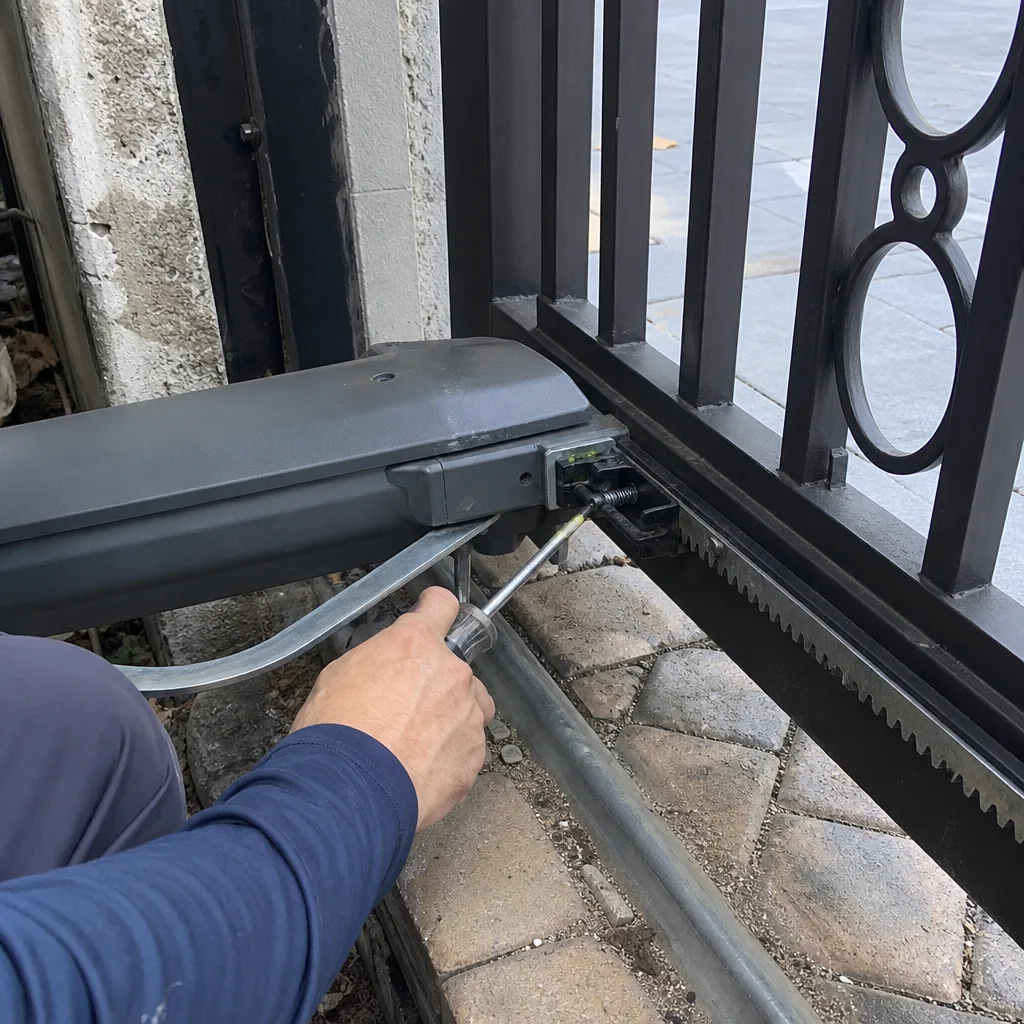
- Replacing the operator battery. Swing and slide gates run on 12V or 24V batteries that fail every two to three years in South Florida heat. Replacement is plug-and-play on most LiftMaster and Mighty Mule units.
- Cleaning the photo-eye lenses. A soft cloth and glass cleaner fixes half the “gate won’t close” calls we see. If the lens is clean and the gate still faults, that’s a real issue.
- Lubricating hinges and rollers. Use a white lithium grease on swing hinges and a silicone spray on slide gate rollers. Boca Raton’s salt air accelerates corrosion, so this is a quarterly chore, not an annual one.
- Tightening visible mounting bolts. Gate hardware loosens over time. A socket set and ten minutes fixes most rattles.
- Clearing track debris. Slide gates in Boca Raton collect sand, palm fronds, and landscaping debris. A clean track is a quiet track.
Needs a Professional: Calibrated Adjustments and Entrapment-Protection Repairs
- Limit switch adjustments. The limit switch tells the motor where to stop. Set it two degrees past travel and the gate slams into the post. Set it short and the gate leaves a gap. Both conditions create liability, because an improperly set limit switch defeats the gate’s travel protection.
- Force reversal sensitivity. UL-325 requires the gate to reverse when it encounters resistance, not just when the photo-eye trips. Adjusting this requires a force gauge and a series of controlled contact tests. Eyeballing it is how children get hurt.
- Photo-eye alignment and replacement. The infrared beam must maintain a clean line of sight. Misalignment by two inches can be enough to cause intermittent failures, and intermittent failures are the worst kind because the gate works during your test and fails during a delivery.
- Capacitor or motor replacement. Swing-gate capacitors store high voltage even after power is disconnected. A motor replacement on a FAAC or Elite operator involves wiring, polarity, and travel calibration.
- Any repair on a shared-access or HOA gate. The liability stack is different when multiple households use the gate. Documentation of compliance is not optional.
Never Touch: Safety Systems and Electrical Mains
- Removing or bypassing a photo-eye. This is not a repair. It’s a liability event waiting for a victim, and any technician who finds one will document it in writing.
- Mains-voltage wiring inside the operator housing. If it’s 120V or 240V, it’s not a DIY repair. Capacitors inside gate operators hold charge after power is cut and can cause serious injury.
- Welding on a gate leaf while it’s still mounted. The heat warps the frame, ruins the powder coating, and can damage the motor if the gate is driven while still hot.
Three Repairs That Look Simple and Consistently Cause Expensive Secondary Damage
Every our Gate Repair services team has a version of this list. These are the repairs we see attempted most often by capable homeowners who then pay two or three times the original repair cost to fix the secondary damage.
- Adjusting the limit switch without marking the original position. The limit switch on a swing gate controls both the open stop and the closed stop. Small adjustments create a compounding effect: the gate over-travels, the arm bracket bends, the motor strains against the stop, and within weeks the gearbox strips. A $40 limit-switch adjustment becomes an $800 motor replacement because the original position was never marked. The fix: photograph the cam position, mark it with a paint pen, and only then make the adjustment. If you’re adjusting more than a few degrees, stop and call someone who calibrates gates daily.
- Increasing force reversal to “fix” a gate that’s jamming. When a gate starts stalling midway, the first impulse is to crank up the force dial so it pushes through. That works for about a week. Then the underlying problem, usually a worn roller or a warped track, gets worse under the increased force until the motor burns out or the gate bends. Force settings exist to stop the gate when something’s wrong, not to override it. If your gate needs more force to operate, the problem is mechanical, not electrical.
- Replacing a battery without updating the charging parameters. Newer LiftMaster and FAAC control boards track battery chemistry and charging cycles. Dropping in a new battery without resetting the board’s battery profile shortens the new battery’s life from three years to one, because the board is still charging it based on the old battery’s degraded profile. The repair “works,” and then the new battery fails prematurely, and the homeowner blames the battery.
The Documentation Gap: Why an Undocumented DIY Fix Costs More Than the Repair
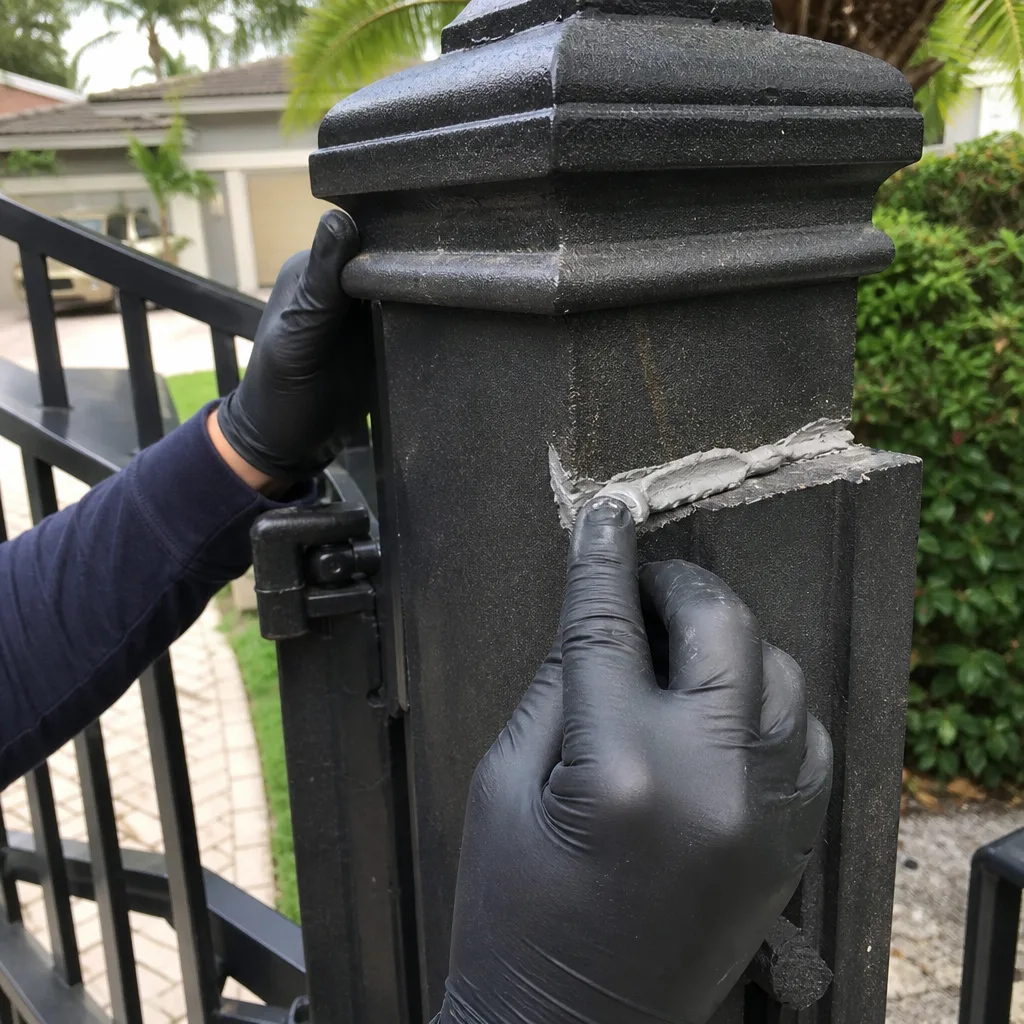
The hidden cost of DIY gate repair isn’t the risk of doing the work wrong. It’s the cost of doing the work right and leaving no record of it.
When you hire a professional to work on your gate, the invoice is a legal document. It lists what was found, what was adjusted, and what was installed. If the gate fails again in eight months, the next technician reads the invoice, sees the part number, sees the settings that were recorded, and picks up where the last person left off.
When you do the work yourself, none of that exists. The gate fails again in eight months, and the technician starts from zero. They have to re-diagnose the problem from scratch, verify the diode orientation in the wiring harness, re-test entrapment protection, and figure out whether the capacitor you replaced was the right spec. You paid for the part once. Now you’re paying for the diagnosis a second time.
That’s the documentation gap, and it’s the single most expensive hidden cost in DIY gate work. The repair saves you $150 in labor, and then it costs you $250 in re-diagnosis time a year later because the record doesn’t exist.
We see this in Boca Raton regularly. A homeowner replaces a Mighty Mule control board, doesn’t note the revision number, and the next technician spends an hour identifying the board revision because the wrong revision uses a different wiring harness. The part was $90. The re-diagnosis was $185. The record would have been free.
That’s why we operate under the Vance Gate Repair Boca Raton home Haven Standard: every visit, whether repair or inspection, leaves a written scope, a written price, and a photographed record of what was found and what was set. The documentation isn’t an upsell. It’s the difference between fixing a gate once and fixing it twice.
Warranty Voids and UL-325 Compliance: What Self-Performing Actually Cancels
Gate operator warranties are written with an assumption: a qualified technician does the work. Most major brands, including LiftMaster, FAAC, Mighty Mule, and Linear, void or limit warranty coverage when a homeowner opens the operator housing and performs a repair.
Read the fine print on your operator manual. It typically says something like “warranty void if opened by unauthorized personnel” or “warranty applies only to professionally installed and serviced units.” That’s not a scare tactic. That’s the manufacturer’s way of limiting liability for boards that were damaged by static discharge, incorrect wiring, or capacitor mishandling.
UL-325 compliance is a separate question, and it’s the one that matters more in an injury claim. UL-325 is the safety standard governing automatic gate operators. It requires:
- Photo-eye entrapment protection on every automatic gate.
- Force reversal that stops and reverses the gate when it encounters resistance.
- Travel limits that prevent over-travel and mechanical damage.
- Warning signage on both sides of the gate.
When a homeowner adjusts any of these without a calibrated frame of reference, the gate may function but no longer meet the standard. The problem is that UL-325 compliance isn’t visible. A gate can open and close perfectly and still fail the entrapment test. The only way to know is to test it, and testing it properly requires the tools and the record.
If you replace a gate battery or clean a track, your warranty is intact and your compliance is unchanged. If you open the operator housing and start moving limit cams, you’re now the person who owns the compliance status of that gate. That’s a weight most homeowners don’t want to carry, and it’s one of the clearest dividing lines in this guide.
How to Document a DIY Gate Repair That a Future Technician Can Actually Build On
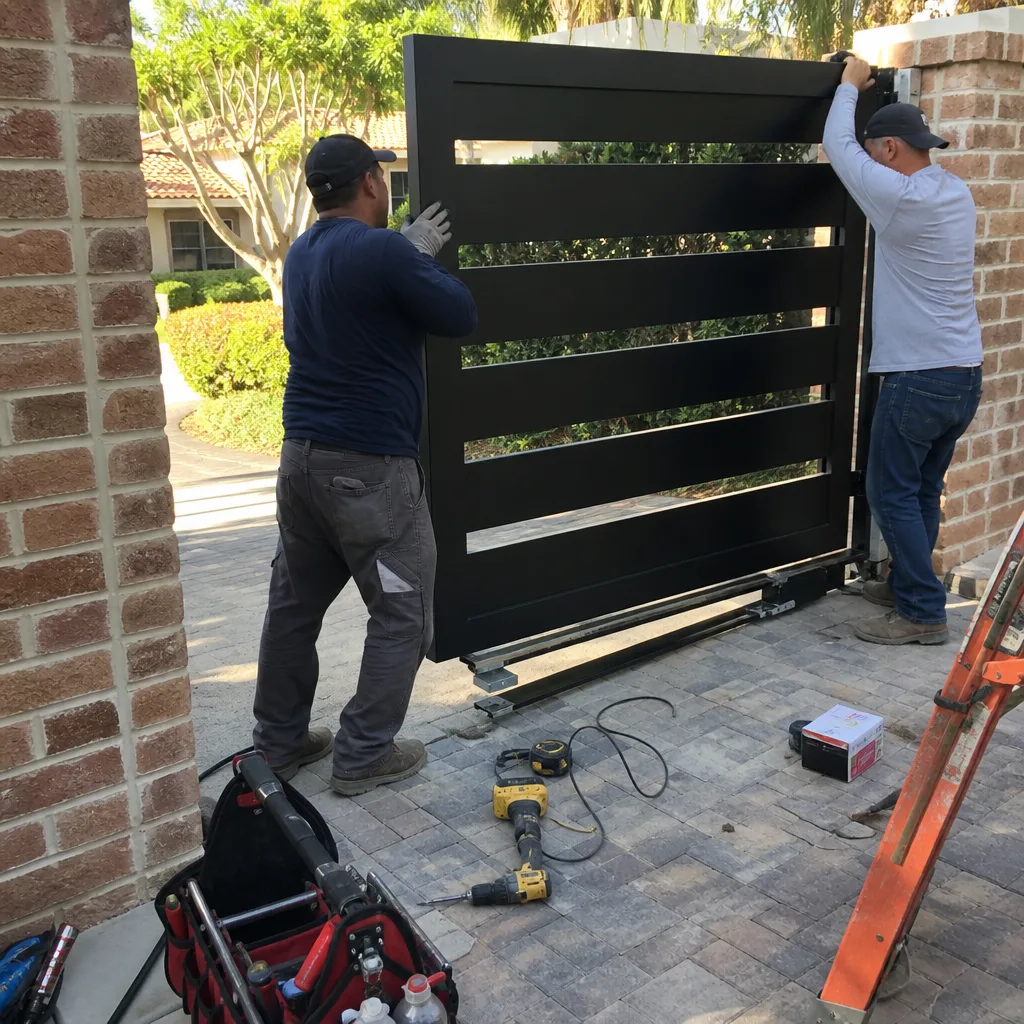
If you’re going to do the work yourself, document it like a technician would. The goal is a record that answers three questions for whoever comes next: what did you find, what did you change, and what’s the baseline now?
Here’s the process, in order:
- Photograph everything before you start. Take a photo of the operator housing with the cover on, then with the cover off. Photograph the wiring harness connections before you disconnect anything. Photograph the limit switch cams, the force dial settings, and the battery orientation. These photos are your baseline. If something goes wrong, they’re also your map back.
- Write down the make, model, and serial number of the operator. Find it on a nameplate inside the housing or on the back of the board. This is the single most useful piece of information for a future technician, and most homeowners skip it.
- Record every setting before you change it. Limit cam positions, force dial numbers, DIP switch settings on the board. A written list is better than a photo because it’s searchable later.
- Document the repair as you do it. Note the part number you’re installing, the orientation of the wiring, and any torque settings. Take a photo of the new part in place before you close the cover.
- Close with a brief note, dated and signed. Something like: “Replaced 12V 7Ah battery with Duracell DURA12-7F. Photographed board before and after. No settings changed.” That note, kept with the operator manual, saves a future technician 45 minutes of tracing.
- Test the gate’s entrapment protection after you finish. Even if you didn’t touch the safety systems, test them. Place an object in the gate’s path and confirm it reverses. If it doesn’t, stop and call a professional. A gate that doesn’t reverse is a gate that’ll hurt someone.
This takes 15 extra minutes and costs nothing. It’s the difference between a repair and a record, and it’s the difference between a future service call that costs $150 and one that costs $400.
Boca Raton-Specific Factors: Salt Air, HOA Rules, and Hurricane Season
Boca Raton isn’t just a location on a service map. It’s a specific environment that changes how gates fail and how they should be maintained.
Salt air corrosion. Every gate east of I-95 in Boca Raton lives in a salt-air environment. Hinges corrode faster, control boards develop white residue on terminals, and wiring connectors oxidize. A gate that works fine for years in suburban Atlanta fails in three years in Boca Raton because the environment is actively corrosive. That’s why quarterly hinge lubrication matters here more than it does almost anywhere else in Florida. It’s also why we use marine-grade grease on swing gates near the Intracoastal.
HOA and shared-access gates. A significant percentage of Boca Raton residential gate work involves gates that belong to a community association, not an individual homeowner. That changes the liability calculus. When a gate serves 40 homes, the HOA’s insurance policy is in play, and the board typically requires documented proof that repairs meet UL-325 compliance. A DIY repair without a documented test record can put a homeowner in conflict with their own board, especially if the gate later fails and the insurance claim asks for maintenance records.
Hurricane season preparation. From June through November, gates in Boca Raton face wind loading, flying debris, and power surges. A gate that’s already weak in its mounting posts becomes a hazard in 80 mph winds. We recommend every homeowner do a pre-season inspection: check hinge bolts, verify the gate doesn’t sag on its mounts, confirm the manual release works, and test the battery backup if the operator has one. A manual release that doesn’t work is an emergency when a hurricane is 48 hours out and you need to open the gate without power.
Heat and battery life. Boca Raton summers shorten gate battery life. Batteries rated for five years fail in two to three here, because sustained heat accelerates the chemistry. If you’re going to DIY one thing per year, make it the battery resistance test, not the battery replacement. Resistance testing tells you whether the battery is actually degraded or whether the charging board is the problem. Replacing batteries blindly is how you buy a new battery and still have a dead gate in two months.
What DIY Actually Saves (and What It Costs in Tooling and Time)
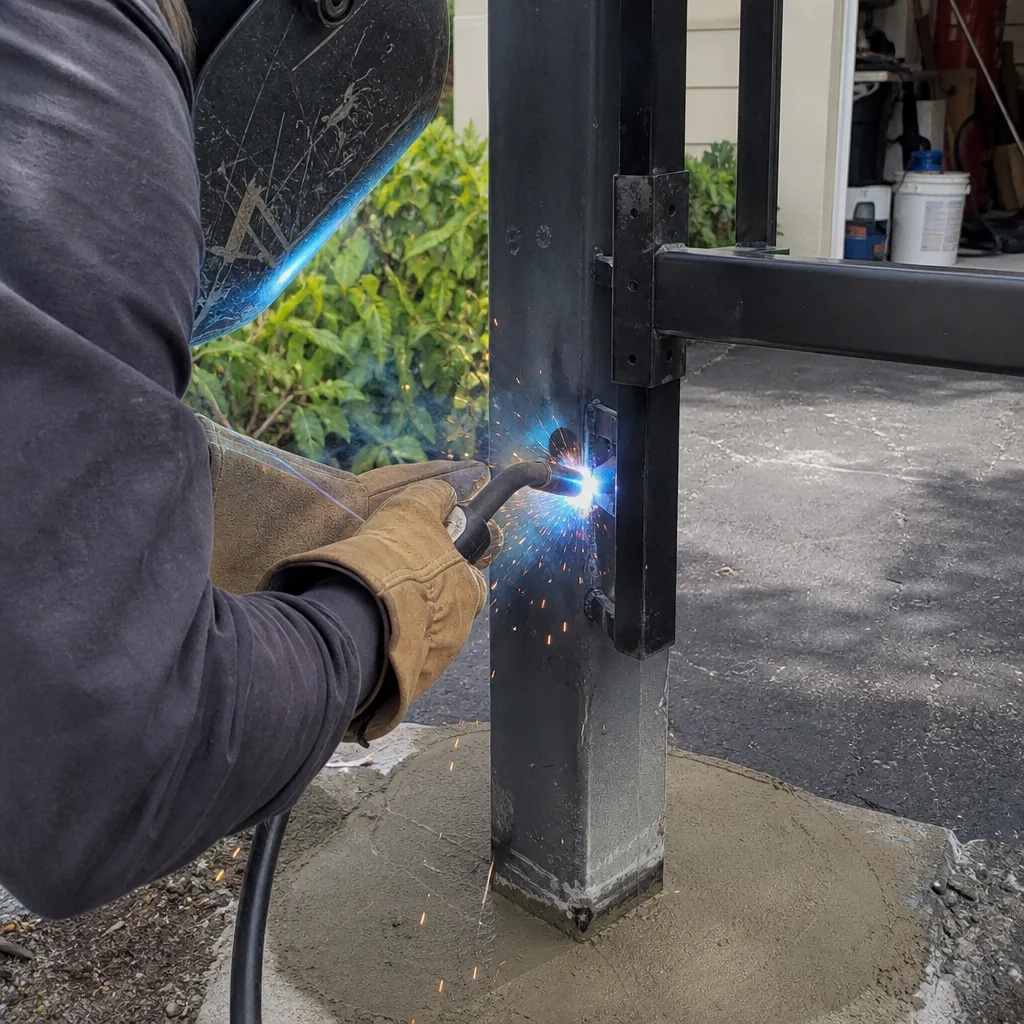
The honest answer to “is DIY worth it” depends on the repair, and it depends on whether you value your time at zero.
Here’s the real math for common Boca Raton gate repairs:
- Battery replacement: $25 to $70 for the battery, 20 minutes of work. Professional cost: $120 to $200. DIY wins, clearly.
- Photo-eye cleaning: $0, 10 minutes. Professional cost: $85 to $125 for a service call. DIY wins, obviously.
- Hinge lubrication: $10 for grease, 30 minutes including cleanup. Professional cost: $95 to $140. DIY wins, quarterly.
- Limit switch adjustment: $0 in parts, but requires a calibrated understanding of travel geometry. Professional cost: $125 to $225. Professional wins, because the cost of a botched adjustment is a $600 to $1,100 motor replacement.
- Force reversal setting: $0 in parts, but requires a force gauge and controlled testing. Professional cost: $100 to $180 as part of a service call. Professional wins, because this is an entrapment-protection safety setting.
- Capacitor replacement: $20 to $45 for the capacitor, but the discharge procedure is hazardous without training. Professional cost: $150 to $260. Professional wins, and the risk of electrical injury alone justifies it.
- Full operator troubleshooting: $0 in parts if you already have a multimeter, but hours of diagnostic time with no guarantee of a diagnosis. Professional cost: $85 to $150 for a diagnostic visit. Professional wins, because the diagnostic visit includes the calibration check and the written record.
The pattern is clear. DIY wins on tasks that don’t require calibration, don’t involve entrapment-protection settings, and don’t leave you as the last person who touched a safety-critical system. Professional wins on everything else, not because the work requires magic, but because the work requires a calibrated baseline and a documented record.
Boca Raton Gate Repair Cost Ranges
Prices in Boca Raton run slightly higher than the Florida state average-see our Gate Repair Cost Breakdown: The Boca Raton Homeowner’s Reference for 2026 for full details-mostly due to real estate costs and the density of gated communities with higher-spec operators. Here’s what you should expect to pay for common repairs from a licensed, insured gate contractor in Boca Raton:
- Service call and diagnostic visit: $85 to $150, typically waived if you approve the repair on the same visit.
- Swing gate motor replacement (parts and labor): $850 to $1,600, depending on brand and whether the arm bracket is reusable.
- Slide gate motor replacement: $950 to $1,900, with higher-end LiftMaster and FAAC units at the top of the range.
- Control board replacement: $350 to $850, including board, installation, and recalibration.
- Photo-eye replacement and alignment: $150 to $300 per set, installed and tested.
- Limit switch adjustment: $125 to $225, including the documented before/after settings.
- Battery replacement (customer-supplied battery): $45 to $95 for installation, if you’ve already bought the battery.
- Welding repair on a swing gate leaf: $300 to $700, depending on the extent of the crack and whether the gate must be removed from its mounts.
These are real ranges we quote in Boca Raton every week. Every quote is written and handed over before any work starts. If a company won’t put the price in writing before they pick up a tool, walk away.
Common Mistakes to Avoid
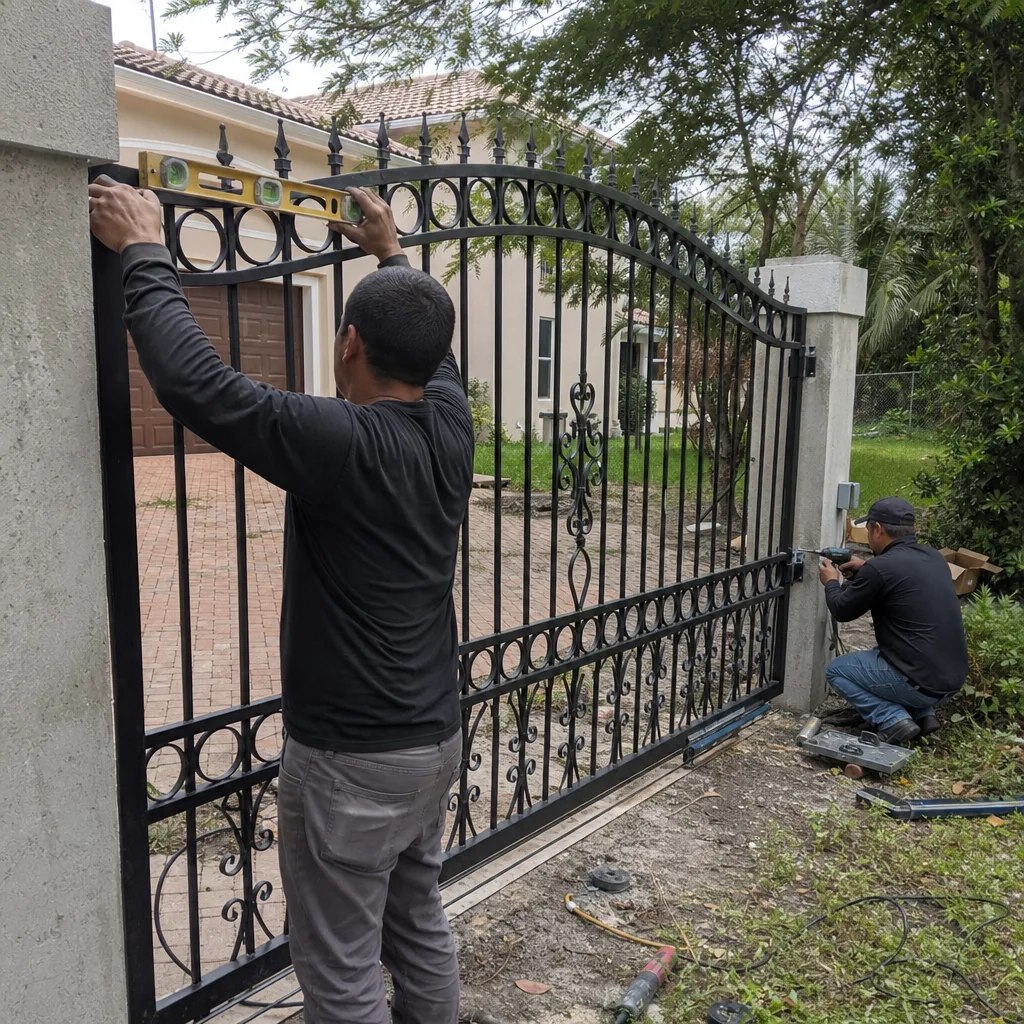
- Increasing force reversal to “fix” a binding gate. Force settings exist to stop the gate when something’s wrong. Cranking the dial masks a mechanical problem until it destroys the motor or bends the gate frame.
- Replacing a battery without testing the old one. Borrow a multimeter or buy a $15 battery tester. If the old battery still holds a charge, the problem is the charging circuit, not the battery, and a new battery won’t fix it.
- Adjusting limit switches without marking the original position. Paint pen, photo, written note. If the adjustment makes things worse, you can always dial back to the original position. Without the original position, you’re guessing from scratch.
- Bypassing a photo-eye because it was “annoying.” The photo-eye is the single most important entrapment-protection device on the gate. Bypassing it is not a repair. It’s a removal of the gate’s primary safety system, and in the event of an injury, it converts a possible claim into a near-certain one.
- Doing any repair on a shared HOA gate without board approval. HOA gates in Boca Raton are governed by community documents that typically require licensed service and documented compliance. Self-performing work on a shared-access gate exposes you to board liability and HOA fines.
- Failing to test the manual release after any repair. The manual release is what lets you open the gate during a power outage or hurricane evacuation. If it didn’t work before the repair, it doesn’t work after the repair, and the recent repair becomes the scapegoat.
- Skipping hurricane-season mounting inspection. Gate mounting bolts loosen over time in Boca Raton’s sandy soil. A gate that’s loose on its posts before a storm becomes a projectile during one. A 20-minute bolt check in May prevents a $2,000 repair in October.
When to Call a Professional
Call a professional when the repair involves any entrapment-protection setting: limit switches, force reversal, photo-eye alignment, or board calibration. Call when the gate is on a shared-access or HOA property, because the documentation burden is higher than most homeowners want to carry. Call when you’ve already done a repair yourself and the gate is still failing, because the secondary diagnosis is always more expensive than the primary repair. Call when you open the operator cover and see capacitors, because the shock risk is real even with the power cut. And call when you want a written price before the work starts, a photographed record when it’s done, and a one-year promise that covers the repair if it fails. Vance Gate Repair Boca Raton offers free estimates in Boca Raton, and every quote is written and handed over before any work begins. Call (754) 666-7602 and a live person answers.
Frequently Asked Questions
Yes. Gate battery replacement is a straightforward DIY task on most swing and slide gate operators, including LiftMaster, Mighty Mule, and FAAC units. Purchase a battery with the same voltage and amp-hour rating as the original, photograph the wiring before you disconnect anything, and test the old battery first to confirm it’s actually the problem. Expect to pay $25 to $70 for the battery and spend 20 minutes on the job. Call (754) 666-7602 if you’d rather have it installed and documented professionally. Estimates are free.
A misadjusted limit switch causes the gate to over-travel into the stop, which bends the arm bracket and strips the motor gearbox, or under-travel, which leaves a gap at the close position. Both conditions create liability because the gate’s travel protection is no longer correct. A limit switch adjustment in Boca Raton typically costs $125 to $225 professionally, while the gearbox damage from a botched adjustment typically costs $600 to $1,100.
In most cases, yes, if the repair involves opening the operator housing and changing any setting or component. Most manufacturers, including LiftMaster, Linear, and Mighty Mule, specify that warranty coverage applies only when a qualified technician performs the work. Routine maintenance like battery replacement, track cleaning, and hinge lubrication typically doesn’t affect warranty status, but the safest rule is to check your operator manual before any repair.
Florida liability law doesn’t distinguish between a gate adjusted by a homeowner and one adjusted by a technician. If a gate injures someone, the most recent person who modified the gate’s settings is the likely defendant. For gates in Boca Raton HOA communities, the association’s insurance policy may be the first responder, but if your adjustment was undocumented, the claim can come back to you personally.
Most Boca Raton gate repairs run between $125 and $650, with motor replacements ranging from $850 to $1,900 depending on the operator brand and the condition of the mounting hardware. A service call and diagnostic visit typically costs $85 to $150 and is often waived if you approve the repair on the same visit. Every reputable Boca Raton gate contractor should put the price in writing before starting work. Call (754) 666-7602 for a written estimate.
Yes. Check the manual release mechanism and confirm it works without power. Inspect hinge bolts and mounting posts for looseness and corrosion. Test the battery backup if the operator has one. Clean the track on slide gates and lubricate hinges on swing gates. These are all safe DIY tasks, and a 20-minute pre-season check in May-see our Gate Repair Maintenance Checklist for Boca Raton Homeowners for the full routine-prevents most storm-related gate damage in Boca Raton. If you find something you can’t fix, document it with photos and call (754) 666-7602.
The Bottom Line
DIY gate repair in Boca Raton is not a skill question. It’s a liability question with a documentation requirement. You can safely handle battery replacement, track cleaning, hinge lubrication, and photo-eye lens wiping. You should not handle limit switches, force reversal settings, photo-eye alignment, capacitor replacement, or any repair on a shared-access HOA gate, because those repairs require calibrated tools and a documented compliance record. The most expensive DIY mistake isn’t the one you can see. It’s the undocumented adjustment that voids your warranty, defeats your gate’s entrapment protection, and surfaces as a liability claim after an injury. When in doubt, get a written price and a documented record. Gate repair in Boca Raton doesn’t have to be a guessing game, and the best repairs leave a paper trail.
Written by Adrian Vance, Owner at Vance Gate Repair Boca Raton, serving Boca Raton since 2014.